Sommaire
21V Weishu 胃俞 [胃兪]

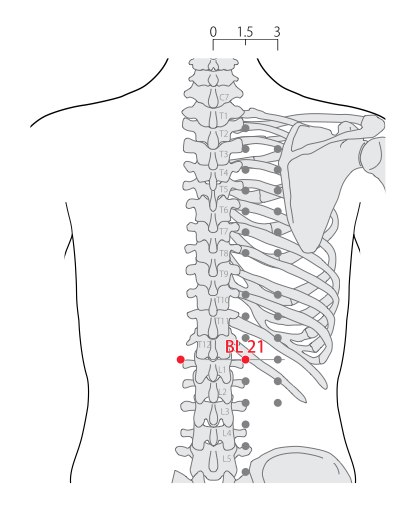
1. Dénomination
1.1. Traduction
| Wèishū 胃输 [胃輸] | Point qui répond à l'estomac (Nguyen Van Nghi 1971) Point correspondant à l'Estomac (Pan 1993) Creux de l'Estomac (Lade 1994 Beishu de l'Estomac (Laurent 2000) |
|---|
- Zhou Mei-sheng 1984 : wei stomach shu pivot; convey.
- Wei : Estomac (Pan 1993), (Ricci 5514) : Estomac (Guillaume 1995) ; Accompagné de la clé organique Rou, 月, (K 130) placée sous le caractère Wei, 田, ce dernier devient l'Estomac (Laurent 2000).
- Shu : transporter (Pan 1993), (Ricci 4462) transporter, offrir (Guillaume 1995) ; transporter, faire écouler… Cf. Naoshu 10IG (Laurent 2000).
Suwen 18 : “Chez le sujet sain le ”Qi“ est continuellement alimenté par l'Estomac” (Laurent 2000).
1.2. Origine
- Mai jing (Guillaume 1995).
1.3. Explication du nom
- Zhou Mei-sheng 1984 : Weishu It leads to the stomach. This point has the function of recuperating the stomach and eliminating stomach irritability
- Lade 1994 : le nom fait référence à la relation de ce point avec l'Estomac. Creux évoque un récipient ou un moyen de transport par lequel passe le Qi circulant (voir V-13, Fei shu).
1.4. Noms secondaires
1.5. Translittérations
- (fra)
- (eng)
- (viet)
1.6. Code alphanumérique
- VE21, 21V, 21VE (Vessie)
- BL21, B21, Bladder 21 (Bladder)
- UB 21 (Urinary bladder)
2. Localisation
2.1. Textes modernes
- Nguyen Van Nghi 1971 : A une distance et demie de la ligne médiane postérieure au-dessous de la douzième vertèbre dorsale
- Roustan 1979 : à 1,5 distance en dehors de la pointe de l'apophyse épineuse de la douzième vertèbre dorsale, au-dessous de la douzième côte (flottante).
- Lu HC 1985 : Location-1 : 1.5 cuns laterally away from the lower end of the spinous process of the 12th thoracic vertebra. Location-2 : On a level with the space between the spinous processes of the 12th thoracic vertebra and lst lumbar vertebra, 1.5 cuns from posterior median line. How-to-locate-1 : Locate this point 1.5 cuns laterally from the depression below the 12th thoracic vertebra. How-to-locate-2 : Let the patient lie on stomach, locate it 1.5 cuns laterally from the region below the 12th thoracic vertebra.
- Deng 1993 : Sur le dos, au-dessous de l'apophyse épineuse de la douzième vertèbre dorsale, à 1,5 cun de la ligne médiane postérieure.
- Pan 1993 : Weishu est situé à 1,5 distance de la ligne médiane du dos, sur la ligne horizontale qui passe au-dessous de l'apophyse épineuse de la douzième vertèbre dorsale.
- Guillaume 1995 : A 1,5 distance en dehors du processus épineux de la douzième vertèbre thoracique, au-dessous de la douzième côte.
- Laurent 2000 : sur le dos, à 1,5 cun en dehors de la 12° épineuse dorsale, au-dessous de la 12° côte.
- WHO 2009: In the upper back region, at the same level as the inferior border of the spinous process of the 12th thoracic vertebra (T12), 1.5 B- cun lateral to the posterior median line.
Items de localisation
- Ligne médiane postérieurs
- Apophyse épineuse de T12
- 12° côte
2.2. Textes classiques
- Jia Yi : Au-dessous de la douzième vertèbre et à 1,5 cun de celle-ci (Deng 1993).
- Tu Yi : Au-dessous de la douzième vertèbre et à 2 cun de la ligne médiane dessinée par la colonne vertébrale. On trouve ce point lorsque le patient est assis, le dos redressé (Deng 1993).
- Deng 1993 : tous les anciens ouvrages de médecine s'accordent sur la localisation de ce point, et c'est la définition de Jia Yi qui prévaut actuellement. Weishu est donc localisé sur le dos, au-dessous de l'apophyse épineuse de la douzième vertèbre dorsale, et à 1,5 cun de la ligne médiane postérieure.
2.3. Rapports et coupes anatomiques
- Roustan 1979 : Artère et veine subcostalis, rami dorsales du nerf subcostalis (12ème nerf intercostal).
- Deng 1993 : Peau—tissu sous-cutané—couche superficielle de l'aponévrose thoraco-lombaire et de l'aponévrose du muscle grand dorsal—muscle érecteur épineux. Dans la couche superficielle, on trouve les branches cutanées des branches postérieures du douzième nerf thoracique et du premier nerf lombaire, et les artères et les veines correspondantes. Dans la couche profonde, on trouve les branches musculaires des branches postérieures du douzième nerf thoracique et du premier nerf lombaire, et les branches ou tributaires des artères et des veines qui s'y, rattachent.
- Guillaume 1995 : Branches postérieures de l'artère et de la veine sous-costales. Rameau médial de la branche dorsale de T11.
2.4. Rapports ponctuels
3. Classes et fonctions
3.1. Classe ponctuelle
- Nguyen Van Nghi 1971 : Point recevant un vaisseau qui vient directement de l'estomac. So Ouenn (Chapitre 28) : « Dans le cas de diarrhée provoquée par l'insuffisance rénale, il faut tonifier le Iu de l'estomac (Oé Iu) et le Iu des reins (Chenn Iu, 23V) » Point utilisé dans les affections de l'estomac par la technique de lu-Mo, le lu de l'estomac est le Oé Iu (21V), le Mo de l'estomac est le Tchong Iuenn (12VC).
- Point Shu du dos correspondant à l'Estomac (Pan 1993, Guillaume 1995)
3.2. Classe thérapeutique
- Roustan 1979 : traite l'estomac, élimine l'humidité.
- Guillaume 1995 : Weishu tonifie la Rate, harmonise l'Estomac, élimine l'humidité, draine les stagnations d'aliments. Selon le Tai yi shen zhen, Weishu harmonise le centre-Zhong, régularise la Rate et l'Estomac, mobilise la stagnation et élimine l'humidité, facilite la digestion.
- Laurent 2000 : en tonification : renforce le Qi de l'Estomac, en dispersion : régularise le Qi de l'Estomac, disperse Shiji (accumulation de nourriture), élimine la chaleur de l'Estomac.
4. Techniques de stimulation
| Acupuncture | Moxibustion | Source |
|---|---|---|
| Selon Tong ren, puncturer à 0,5 distance, laisser l'aiguille le temps de 7 expirations, | Appliquer un nombre de moxas en fonction de l'âge. Selon Ming tang, appliquer 3 cônes de moxa ; 7 cônes, selon Xia jing | Zhen jiu ju ying (Guillaume 1995) |
| Puncture inclinée entre 0,5 et 0,8 distance de profondeur | Cautérisation avec 5 à 7 cônes de moxa, moxibustion pendant 10 à 20 minutes. | Guillaume 1995 |
| Piqûre perpendiculaire à 0,5-1 distance Piqûre sous-cutanée du haut vers le bas à 1-2 distances | Cautériser 3-7 fois, chauffer 5-20 minutes | Roustan 1979 |
| Piqûre perpendiculaire ou oblique de 0,5 à 1 cun | Moxas : 3 à 7; chauffer 15 à 40 mn | Laurent 2000 |
Sensation de puncture
Sécurité
- Roustan 1979 : Ne pas piquer trop profondément.
5. Indications
| Classe d'usage | ★★ | point majeur |
|---|
5.1. Littérature moderne
- Roustan 1979 : douleurs gastriques, gastrite, dilatation de l'estomac, ptose gastrique, maladie ulcéreuse (Maladie ulcéreuse toute affection viscérale qui se traduit par une ulcération quel qu'en soit le siège le long du tractus digestif), entérite, insomnie, dorsalgie. Vomissements, douleurs coliques, diarrhée, œdème.
- Lade 1994 :
- Régularise, fortifie et tonifie la Rate (surtout le Qi et le Yang), régularise l'Estomac (surtout le Qi et le Yin) et le Réchauffeur Moyen, tonifie le Qi Nourricier, réduit les stagnations digestives, clarifie le Feu de l'Estomac, transforme l'Humidité et la Chaleur-Humidité (surtout de la Rate et de l'Estomac), et assèche l'Humidité et le Froid-Humidité. Indications : syndrome de consomption avec soif du Réchauffeur Moyen, troubles dysentériques, syndrome atrophique par Chaleur-Humidité, hépatite, gastrite, pancréatite, entérite, gastralgie ou douleur épigastrique par Froid et vide de Qi de l'Estomac, douleur ou sensation de suffocation dans la poitrine et les hypochondres, douleur et distension de l'abdomen, perte d'appétit, œdème, mauvaise digestion, borborygmes, flatulences, diarrhée aiguë ou chronique, et douleur au milieu du dos.
- Fait descendre le Qi rebelle. Indications : renvois, régurgitations, vomissements, et difficultés à avaler.
- Guillaume 1995 : Douleur épigastrique, douleur du thorax et des flancs, indigestion, ballonnement abdominal, borborygmes, diarrhée glaireuse, nausées, vomissements, œdème, ballonnement de l'abdomen tendu comme un tambour ; spasmes gastriques, gastrite, distension gastrique, ulcère de l'estomac, ptose de l'estomac.
5.2. Littérature ancienne
- Jia yi jing : Ballonnement de l'Estomac de type froid, amaigrissement malgré une alimentation abondante, plénitude abdominale avec borborygmes, Jue de type vent, plénitude du thorax et des flancs ; vomissement ; raideur douloureuse de la colonne vertébrale ; spasmes des tendons ; inappétence » (Guillaume 1995).
- Su wen : Chapitre « Commentaires sur les vacuités et les plénitudes » de Wang Bing : « Diarrhée cholériforme » (Guillaume 1995).
- Ishimpo : Froid de l'Estomac ; aspect émacié du corps bien que le sujet mange et boive abondamment ; ballonnement ; borborygmes ; plénitude abdominale ; affection de type vent et froid ; distension thoracique (Guillaume 1995).
- Sheng hui fang : « Plénitude et gêne abdominale avec vomissement », « Le Qi monte et descend au niveau du dos avec des douleurs de la colonne lombaire », « Amaigrissement des enfants avec inappétence » (Guillaume 1995).
- Zi sheng jing : « Douleur abdominale (Guillaume 1995).
- Zhen jiu ju ying : diarrhée cholériforme, froid de l'Estomac, ballonnement avec borborygmes, nausée, vomissement, inappétence, amaigrissement malgré une alimentation abondante, vue trouble, douleur abdominale, distension du thorax et des flancs, contracture des tendons et douleur de la colonne vertébrale, amaigrissement des enfants ». Li Dongyuan dit : « En cas d'humidité du Réchauffeur moyen, le traitement, c'est Weishu-21V » (Guillaume 1995).
- Yi xue ru men : « Plénitude des flancs, douleur de la colonne vertébrale, ballonnement abdominal, douleur abdominale, borborygmes, vomissement, inappétence, tendons et vaisseaux contractés » (Guillaume 1995).
- Da cheng : Reprend intégralement la citation du Zhen jiu ju ying (Guillaume 1995).
- Xun jing : « Faiblesse et froid de l'Estomac, vomissement de liquide clair » (Guillaume 1995).
- Lei jing tu yi : « Froid de l'Estomac avec vomissement par reflux, nausées, diarrhée cholériforme, ballonnement abdominal avec plénitude et distension, amaigrissement et fatigue de la peau, borborygmes, douleur abdominale, inappétence, douleur de la colonne dorsale avec spasmes et contractures des tendons, amaigrissement de l'enfant avec inappétence et absence de prise de poids. Diarrhée glairo-sanguinolente des enfants avec prolapsus rectal à la fin de l'automne, douleur abdominale insupportable, faire des moxas de la taille d'un grain de blé ». « Selon certains, il traite l'œdème et le ballonnement de l'abdomen qui est comparable à un tambour, la présence de gaz au niveau du diaphragme avec inappétence, la diarrhée chronique, la présence de masse ancienne-ji kuai dans l'abdomen » (Guillaume 1995).
- Tai yi shen zhen : « Nausées et vomissements dus au froid de l'Estomac, inappétence, choléra, douleur et ballonnement abdominal, dyspepsie de l'enfant, amaigrissement et perte de l'appétit, dysenterie et selles sanguinolentes, prolapsus rectal » (Guillaume 1995).
5.3. Associations
| Indication | Association | Source |
|---|---|---|
| Gonflement de l'Estomac de type froid avec amaigrissement malgré une alimentation abondante | 21V | Qian jin (Guillaume 1995) |
| Froid de l'Estomac avec indigestion. | 21V + 47V | Bai zheng fu (Guillaume 1995) |
| Gastrite chronique | 21V + 20V + 36E + 12VC | Roustan 1979, Shanghai zhen jiu xue (Guillaume 1995). |
| Douleur épigastrique | 21V + 12VC + 13VC + 6MC + 36E + 4Rte | Zhong hua zhen jiu xue (Guillaume 1995) |
| Ulcère gastrique | 21V + 20V vers 12VC vers 13VC | Roustan 1979 |
| Diarrhée des enfants | 21V + 9VC + 25E + 8VC | Tu yi (Guillaume 1995) |
5.4. Revues des indications
- Suzudi et al. [Signification physiologique et effets de l'acupuncture au point Weishu]. Second National Symposium on Acupuncture and Moxibustion, Beijing. 1984:45. [8596].
- Yuan Cunxin et al. The Curative Effect and Mechanism of Action of the Acupoints Pishu and Weishu. Journal of Traditional Chinese Medicine. 1986;6(4):249-52. [20389].
- Yuan Cunxin et al. Studies on the Clinical Therapeutic Effect and Action Mechanism of Pishu (B 20) and Weishu (B 21) Points. Chinese Journal of Acupuncture and Moxibustion. 1988;1(3-4):28-31. [80582].
The clinical therapeutic effect and mechanism of 134.ck Shu (Pishu, Weishu) were studied since 1978. (1) The total effective rate in 70 cases with stomachache treated by needling Pishu, Weishu was 93.94%. There was significant difference as compared with the control group. (2) Among the 33 cases of subtotal gastrectomy and gastroduodenal ulcer before operation, there was 89.39% tenderness reactive points concentrated on pishu and Weishu and those points between them, rope from reactive mass could be touched in 53.03%. (3) A direct observation of the influence of needling Pishu and Weishu on the peristalsis of the stomach was performed by the application of fiber gastroscope. After needling, the rate of changes of movement of the stomach was 93.33%. There were significant differences as compared with the control group. In our observations, it was indicated that there may be relative regularities and specificities between Shu points and Zang Fu organs and function of the vegetative nervous system.
6. Etudes cliniques et expérimentales
6.1. Gastralgie
- Xu Peichang et al. Clinical Observation on Treatment of Acute Epigastralgia by Puncturing Liangqiu and Weishu Acupoints. International Journal of Clinical Acupuncture. 1991;2(2):127-30. [84201].
- Cai Guo-Wei et al. Comparison of Effects on Arresting Stomachache by Needling Weishu or Weishu-Like Points. International Journal of Clinical Acupuncture. 1995;6(4):423-6. [56228].
Stomachache is often encountered clinically and cured effectively by acupuncture treatment. However, there have been few reports on a quantitative analysis of their pain-killing effects. The authors employed a pain scale to score the level of pain quantitatively in patients with stomachache, and compared effects of electroneedling treatment on Weishu (BL 21) and Weishu-like points using such scores, the results show better effects with Weishu-like points. A report follows.
- Wang Lu-Sha, et al. Effect of Acupuncture of “Zusanli” and “Weishu” Acupoints on Experimental Gastric Ulcer. World Journal of Acupuncture-Moxibustion. 2003;13(1):24. [116962] LIEN SUR [121643] ?????.
Objective : To observe the therapeutic effect of electroacupuncture (EA) of “Zusanli” (ST 36) and “Weishu” (BL 21 ) on the experimental gastric ulcer in Xu-period of a day for analyzing the best opportunity of acupuncture treatment of gastric ulcer. Methods : 49 Wistar rats were randomly divided into 1 control group, (2) ST-36-Xu group, (1) BL-21 1 -Xu group, (4) ST-36-Chen group, 5 BL-21 1 -Chen group, (P ST-36-IT group, and (7) BL-21 1 -IT group, with 7 rats in each group. Rat gastric ulcer model was established using intra-gastric administration of glacial acetic acid. Gastric mucosal thickness, mucosal muscular defect width, superficial mucosal mucus index (MI) , intramucosal MI , Total Mi, plasma 6-keto-PGF 1 a , serum NO and gastric tissue CGRP concentrations were used as the indexes. The EA treatment was conducted once daily at Xu-period (7 - 9 o'clock in the evening), Chen-period (8 - 10 o'clock in the morning) and irregular time (IT) with 6 days being a therapeutic course, two courses altogether. Results: After EA treatment, 1 the regenerated mucosal thickness values of the aforementioned 6 EA groups. particularly ST-36-Xu group and BL-21-Xu group, were all apparently higher than that of control group (P< 0. 05 - 0. 01), while the mucosal muscle layer defect width values of different EA groups, particularly ST-36-Xu group and BL-21-Xu group, were strikingly lower than that of control group (P < 0. 05 - 0. 01 ); Othe 3 MI of the 6 EA groups, particularly those of ST-36-Xu group were all significantly higher than those of control group (P< 0. 05 - 0. 0 1); (3) plasma 6-keto-PGF1a contents of the 6 EA groups, particularly those of ST-36-Xu and BL-21 I -Xu groups, were all significantly higher than that of control group (P< 0 - 05 - 0. 01); 4 serum NO and gastric tissue CGRP concentrations of the 6 EA groups, particularly those of ST-36-Xu and BL-21-Xu groups and CGRP concentration of ST-36-Chen group, were all significantly higher than those of control group (P<0. 05 - 0. 0 1); and 5 there were positive correlation between superficial Mi or total MI and NO level (r= 0. 858, 0. 987, P< 0. 05,and 0. 01), and between the superficial mucus index and CGRP concentration (r= 0. 9051, t = 4. 68, P < 0. 01 ), suggesting that the increase of the secretion function of the regenerated mucosal mucus is related to acupuncture induced increase of release of both NO and CGRP. Conclusion : The therapeutic effect of EA of ST-36 and BL-21 in Xu-period is better in the treatment of gastric ulcer. and that of EA of ST-36 is the best.
- Li Miuyi, Sun Jinghui. [Clinical Observation on Tract Reaction Inhibited by Injecting Qumaduo into Weishu Acupoint]. Journal of Zhejiang College of TCM. 2004;28(6):60. [139156].
- Zhang X, Cheng B, Jing X, Qiao Y, Gao X, Yu H, Zhu B, Qiao H. NMDA Receptors of Gastric-Projecting Neurons in the Dorsal Motor Nucleus of the Vagus Mediate the Regulation of Gastric Emptying by EA at Weishu (BL21). Evid Based Complement Alternat Med. 2012. [165993].
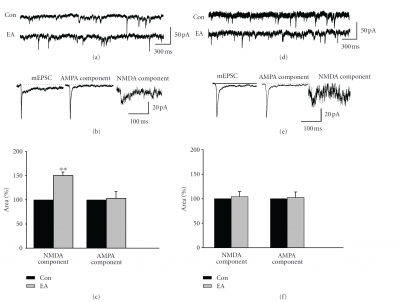 Effect of EA at BL21 on mEPSCs in labeled and unlabeled DMV neurons. (a) Representative traces of mEPSCs of labeled neurons in control and EA groups. (b) Representative AMPAR and NMDAR components of mEPSC (average over 100 events) in labeled neurons. From left to right: mEPSC containing AMPAR and NMDAR components, isolated AMPAR component, isolated NMDAR component. © With regard to labeled neurons in EA group, NMDAR component was increased significantly, but AMPAR component did not change significantly (∗∗P < 0.01, unpaired t test, n = 12 neurons for each group). (d) Representative traces of mEPSCs of unlabeled neurons in control and EA groups. (e) AMPAR and NMDAR components of mEPSC (average over 100 events) in unlabeled neurons. From left to right: mEPSC containing AMPAR and NMDAR components, isolated AMPAR component, isolated NMDAR component. (f) With Regard to unlabeled neurons in both control and EA groups, neither NMDAR nor AMPAR component changed significantly (n = 8 neurons for each group) (Zhang 2012).
A large number of studies have been conducted to explore the efficacy of electroacupuncture (EA) for the treatment of gastrointestinal motility. While several lines of evidence addressed the basic mechanism of EA on gastrointestinal motility regarding effects of limb and abdomen points, the mechanism for effects of the back points on gastric motility still remains unclear. Here we report that the NMDA receptor (NMDAR) antagonist kynurenic acid inhibited the gastric emptying increase induced by high-intensity EA at BL21 and agonist NMDA enhanced the effect of the same treatment. EA at BL21 enhanced NMDAR, but not AMPA receptor (AMPAR) component of miniature excitatory postsynaptic current (mEPSC) in gastric-projecting neurons of the dorsal motor nucleus of the vagus (DMV). In sum, our data demonstrate an important role of NMDAR-mediated synaptic transmission of gastric-projecting DMV neurons in mediating EA at BL21-induced enhancement of gastric emptying.
- Wang H, Shen GM, Liu WJ, Huang S, Zhang MT. The Neural Mechanism by which the Dorsal Vagal Complex Mediates the Regulation of the Gastric Motility by Weishu (Rn12) and Zhongwan (BL21) Stimulation. Evid Based Complement Alternat Med. 2013. [166796].
 Effets de l'électroacupuncture EA au 12VC et 21V sur la pression intragastrique (Wang 2013)
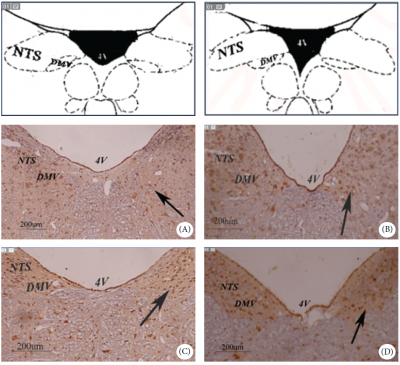 Immunoréactivité de c-fos sur le complexe vagal dorsal (noyau moteur dorsal du Vague DMV + noyau du tractus solitaire NTS). En haut localisation anatomique. En bas : A) Groupe modèle; B)EA au 12VC; C) EA au 21V; D) EA 12VC et 21V (Wang 2013)
A large number of studies have been conducted to explore the mechanism of Back-Shu and Front-Mu points. While several lines of evidence addressed the acupuncture information of Shu acupoints and Mu acupoints gathering in the spinal cord, whether the convergence is extended to the high centre still remains unclear. The study selected gastric Mu points (RN12) and gastric Shu points (BL21) regulating gastric motility and its central neural mechanisms as the breakthrough point, using the technique of immunochemistry, nuclei lesion, electrophysiology, and nerve transection. Here, we report that gastric motility regulation of gastric Shu and Mu acupoints and their synergistic effect and the signals induced by electroacupuncture (EA) stimulation of acupoints RN12 and RN12 gather in the dorsal vagal complex (DVC), increasing the levels of gastrointestinal hormones in the DVC to regulate gastric motility through the vagus. In sum, our data demonstrate an important role of DVC and vagus in the regulation of gastric motility by EA at gastric Shu and Mu points.


6.2. Intestin
- Fukuyama Junji Miller et al. Effect of Moxibustion in the Acupoints B-27 (Xiaocangshu), VC-4 (Guanyuan), B-21 (Weishu) and VC-12 (Zhongwan) in Xiaochang (Intestino Delgado [Intestin grêle]). Revista Paulista de Acupuntura. 1998;4(2):68-4. [72729].
The objective of this work is to study the effect of the moxibustion in the acupointsShu-Mo corresponding to Wei (stomach) and to Xiaochang (smallintestine)in gastrointestinal motility Material- 68 female EPM-I/Wistar rats were used, weight ranging from 195 to 230 grams;pasty substance made of powdered coal (28.57%), powdered Arabic gum (28.57%), and filtered water (42.85%), and moxa in stick.Methods - The animals were kept on a 24 hour fast, randomly distributed in 4 groups of 17 female rats each, submitted the administration of 1.5 ml of the pasty substance of coal, with previous superficial anesthesia of sulfuric ether, and submitted to the following procedures. Control Group (1): The female rats were returned to the cage. MOXA GROUP (11): The female rats were kept under anesthesia with sulfuncether, the acupoints B-21 (Weishu), B-27(Xiaochangshu), VC-12 (Zhongwan) and VC-4 (Guanyuan) were located and the moxibustion technique was performed for 5 minutes under narcosis. At the end of moxibustion the female rats were returned to the cage. Sham Group (IlI):non-acupoints were located (bilateral anterior axillary area) and the moxibustion technique was performed for 5 minutes, under narcosis. Ether Group (IV): The female rats were kept under an esthesia with sulfuric ether for 5 minutes. At the end of the scheduled time, they were returned to the cage. All animals in the 4 groups were sacrificed with sulfuric ether in the twentieth minute of the experiment. Surgical removal of the small intestine and clamping of the distal portion reached by the coal were performed, and the progression distance of coal since the pylorus and the total length of the small intestine were measured. Results - Kruskal-WalJis points variance analysis and the multi comparison test showed that groups Control and Moxa did not present much difference, and had an absolute progression of coal that was significantly longer them Sham and Ether groups. As to the length of the small intestine, no significant value among the groups was found. Vanance analysis of Kruskal-WaDispoints showed as regards the percent ratio (coal progression/length of smal intestine), that the Control and Moxa groups did not vary significantly and that they exhibited a significantly higher percent than the values observed in the Sham and Ether Groups.