Sommaire
8VC Shenque 神阙(神闕)


1. Dénomination
1.1. Traduction
| Palais de l'énergie (Nguyen Van Nghi 1971) Porte du palais du Shen (Pan 1993) Porte du palais de l’esprit (Lade 1994) Porte de la vitalité (Laurent 2000) |
- Shen (Ricci 4317) : les esprits, divinités, génies, divin, l'Esprit suprême, Dieu, principe vital supérieur, vitalité (Guillaume 1995).
- Que (Ricci 1426) : tours de guet devant la porte du palais impérial, palais impérial (Guillaume 1995).
1.2. Origine
La dénomination de ce point apparaît dans le Jia yi jing (Guillaume 1995).
1.3. Explication du nom
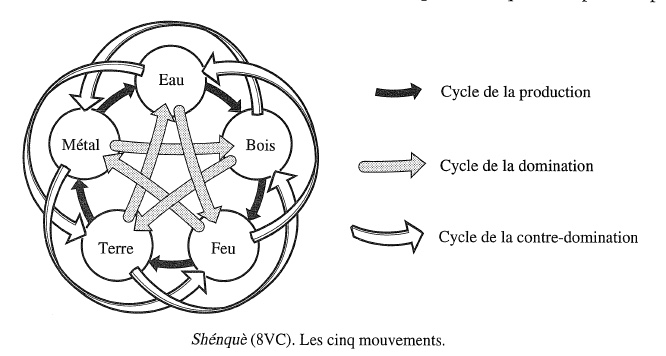
- Pan 1993 : On dit que la formation de l'embryon commence par celle du cordon ombilical, lequel ressemble à la tige d'une fleur de lotus. L'eau du Ciel donne naissance aux Reins, qui ont l'aspect d'un bourgeon de lotus. Ensuite, les organes se forment suivant le principe de la « production réciproque » des cinq éléments : l'Eau (Reins) produit le Bois (Foie), le Bois produit le Feu (Cœur), le Feu produit la Terre (Rate), la Terre produit le Métal (Poumon), le Métal produit l'Eau. Au dixième mois lunaire de la conception, lorsque tous les organes sont complètement formés, le souffle du Shen entre dans le fœtus par le point Shenque et fait de lui un humain. Le corps est le palais qui contient le Shen, le point Shenque est la porte du palais.
- Lade 1994 : le nom fait référence à l'endroit par où pénètre la force vitale ou l'Esprit, pendant le développement du fœtus. Porte du Palais évoque une voie d'entrée et une protection. Shen que est un terme moderne pour l'ombilic.
- Laurent 2000 : Il y a dans cette expression une cascade de jeux de mots et de glissements quant au sens. Shen est à prendre dans le sens vitalité, mais il s'agit du même caractère que celui qui désigne l'esprit et qui se rapporte au Cœur empereur des zang (viscère yin), on pourrait donc se contenter du deuxième sens de que et traduire par “palais impérial”, d'autant plus que le jing jin du méridien du Cœur rejoint l'ombilic. Cependant le sens vitalité reste important puisque c'est par le cordon ombilical que l'enfant, pendant la vie intra-utérine, reçoit la nourriture de sa mère ; la zone ombilicale est son centre et elle est reliée directement au chong mai qui distribue le sang nutritif aux 12 méridiens. Que contient le caractère de la porte et de deux tours de guets, l'image est celle de l'ombilic et des deux grands droits de l'abdomen qui le bordent, protégeant ainsi l'ensemble du ventre. Shenque désigne en définitive l'ombilic. Le point porte un autre nom Qí zhōng 齐中[齊中] : il ne s'agit pas du qi d'énergie mais d'un caractère, qí 齐[齊], qui signifie se régler, s'harmoniser, se purifier pour recevoir les avis du ciel, l'idéogramme est ensuite recatégorisé par la clé organique rou 月 (K 130) pour devenir l'ombilic. Il existe une autre expression Qìzhōng 气中 [氣中] [qui se traduit par “énergie centrale” et qui se rapporte à l'énergie de la Terre/centre (Rate/Estomac). En fait la moxibustion au Qí zhōng 齐中[齊中] (ombilic) renforce Qìzhōng 气中 [氣中], (“énergie centrale”).
1.4. Noms secondaires
| Qí zhōng 齐中[齊中] | Roustan 1979 |
| Qìzhōng 气中 [氣中] (1) | Jia yi jing (Guillaume 1995, Laurent 2000) |
| Wěihuì 维会[維會] (2) | Zhen jing, Xun jing (Guillaume 1995, Laurent 2000) |
| Qìshě 气舍 [氣舍] (3) | Jia yi jing (Guillaume 1995, Laurent 2000) |
| Qìhé 气合 [氣合] (4) | Tong ren (ce serait une erreur de transcription : Guillaume 1995, Laurent 2000) |
| Huángǔ 环谷 [環谷] (5) | Zhen jiu xue ci dian (Guillaume 1995) |
| Mìng dì 命蒂 (6) | Laurent 2000 |
- Qi (Ricci 503) : nombril, ombilic ; Zhong (Ricci 1266) : milieu, centre, dans l'intervalle, intermédiaire, médiateur, l'intérieur, le dedans, le juste milieu, la moitié (Guillaume 1995).
- Wei (Ricci 5512) : fibre, filament ; lier, attacher, joindre, unir ; principe fondamental ; maintenir, sauvegarder, préserver ; Hui (Ricci 2254) : se réunir, s'assembler, rencontrer ; association (Guillaume 1995).
- Qi (Ricci 485) : élément le plus subtil qui entre dans la composition de toutes choses, vapeur, exhalaison, air, gaz ; She (Ricci 4298) : demeure, maison, habitation, hôtellerie, habiter (Guillaume 1995).
- Qi (Ricci 485) ; He (Ricci 1726) : fermer, se fermer, unir, réunir, joindre, additionner, se réunir, se grouper ; ensemble, au total, avec, d'accord, en bonne harmonie, concorde ; associer, apparier, assortir, combiner ; correspondre à, s'ajuster à, convenir à, rencontrer par hasard ; chance imméritée ; entourer complètement, encercler ; convenable, raisonnable, union sexuelle (Guillaume 1995).
- Huan (Ricci 2205) : anneau de jade ; Gu (Ricci 2720) : vallée, ravin, lit d'un torrent entre deux montagnes, gouffre, antre, caverne, souterrain ; se trouver dans une impasse, incapable d'avancer ou de reculer (Guillaume 1995).
- Calice de la vitalité
1.5. Translittérations
- (fra)
- (eng)
- (viet)
1.6. Code alphanumérique
- CV8, 8VC
- JM8
- RM8
- Ren8
2. Localisation
2.1. Textes modernes
- Nguyen Van Nghi 1971 : — Comme son nom l'indique, c'est le point de concentration de l'énergie.
- Roustan 1979, Deng 1993 ; Pan 1993 ; Guillaume 1995 ; Laurent 2000 : le point Shenque se trouve au centre du nombril.
- WHO 2009 : On the upper abdomen, in the centre of the umbilicus
Items de localisation (ensemble des items significatifs décrits dans la littérature permettant une localisation du point):
- Ombilic
2.2. Textes classiques
- Deng 1993: “Au milieu du nombril.” (Jia Yi). Remarque: Tous les anciens ouvrages de médecine s'accordent sur la localisation de ce point.
2.3. Rapports et coupes anatomiques
- Roustan 1979 : Branches d'artères et veine epigastrica superficialis, rameau cutané antérieur du 10° nerf intercostalis.
- Deng 1993 : Zone concernée: Peau—tissu conjonctif—péritoine pariétal. Dans la couche superficielle, on trouve les branches cutanées antérieures de la branche antérieure du dixième nerf thoracique et le réseau veineux péri-ombilical de la paroi abdominale. Dans la couche profonde, on trouve les ramifications de la branche antérieure du dixième nerf thoracique.
- Guillaume 1995 : Artères et veines épigastriques superficielles et inférieures. Rameaux cutanés antérieurs du dixième nerf intercostal.
2.4. Rapports ponctuels
| 24E | 9VC | 24E |
| 16Rn | ↑ ← 8VC → ↓ | 16Rn |
|---|---|---|
| 15Rn | 7VC | 15Rn |
| latéral | côté droit | médial |
| Voir : Les points de l'abdomen |
3. Classes et fonctions
3.1. Classe ponctuelle
3.2. Classe thérapeutique
- Roustan 1979 : Réchauffe le Yang, tonifie la Rate.
- Guillaume 1995 : Shen que tonifie la Rate, harmonise l'Estomac, réchauffe le Yang, récupère le reflux-ni, ouvre les orifices, restaure la conscience. Selon le Tai yi shen zhen : « Shen que réchauffe et consolide le Yang authentique zhen yang, contient l'échappement, rétablit le Yang et réanime, harmonise les Intestins et l'Estomac. »
- Laurent 2000: Point de croisement avec les jing jin des méridiens Rte/C.
4. Techniques de stimulation
| Acupuncture | Moxibustion | Source |
|---|---|---|
| Il est interdit de piquer ce point | Cautériser 7-14 fois (moxa sur sel ou gingembre) | Roustan 1979 |
| Piqûre interdite | Chauffage indirect sur du sel 20 à 50 mn | Laurent 2000 |
- Zhen jiu ju ying (Guillaume 1995) « Selon Su wen, la puncture est interdite en raison du risque d'ulcération grave de l'ombilic et, s'il y a issue de matières, c'est la mort ; appliquer 3 cônes de moxa. Selon Tong ren, moxibustion avec 100 cônes.
- Lei jing tu yi (Guillaume 1995) : « La puncture est interdite car elle peut provoquer une ulcération torpide avec issue de matières, qui évolue vers la mort. ».
- Yi xue ru men (Guillaume 1995) propose de faire 100 moxas, 5 à 7 cônes chez le nourrisson, la puncture est interdite.
- Guillaume 1995 : La puncture de ce point est interdite. Moxibustion au sel avec 5 à 15 cônes de moxa ou réchauffement pendant 15 à 30 minutes.

Sensation de puncture
Sécurité
- Lade 1994 : l'utilisation des aiguilles est contre-indiquée.
5. Indications
| Classe d'usage | ★★ | point majeur |
|---|
5.1. Littérature moderne
- Nguyen Van Nghi 1971 : Point à puncturer dans les cas suivants : borborygmes, douleurs au ventre, dysenterie, diarrhée ininterrompue, apoplexie, vide de l'énergie, membres glacés.
- Roustan 1979 : Entérite aiguë et chronique, diarrhée chronique, tuberculose intestinale, œdème, prolapsus anal. Autres indications : Attaque directe du vent (Zhong Feng), coma, borborygmes.
- Lade 1994 :
- Tonifie, fortifie et régularise la Rate (surtout le Qi et le Yang et l'Estomac (surtout le Qi), régularise les Intestins, réchauffe l'intérieur, et réduit les stagnations digestives. Indications : différents troubles gastro-intestinaux par vide ou par Froid, céphalée par vide, gonflement des lèvres, douleur et froid de l'abdomen, douleur péri-ombilicale, et diarrhée aiguë ou chronique par vide ou par Froid.
- Tonifie les Reins (surtout le Yang, réchauffe le Yang, régularise la Voie des Eaux, restaure les collapsus de Yang, et assèche l'Humidité et le Froid-Humidité. Indications : tous les troubles urinaires, en particulier strangurie, incontinence ou rétention des urines, forme relâchée d'Attaque-de-Vent, troubles par agitation du fœtus, syndromes de collapsus avec frissons et membres froids, insolation, choc, neurasthénie, œdème, douleur abdominale, prolapsus rectal par vide, et leucorrhée avec sang.
- Guillaume 1995 : Attaque directe par le vent avec syndrome d'échappement et refroidissement des quatre membres, borborygmes et douleur abdominale, œdème et ballonnement, diarrhée dysentériforme, constipation, prolapsus rectal ; les entérites aiguës ou chroniques, dysenteries bacillaires, brides intestinales.
- Laurent 2000 : Le point ne se pique pas, il se chauffe avec des cônes d'armoise posés sur du sel de mer moulu (sinon gare à l'éclatement des cristaux de sel). Point lié au Foyer Moyen et à l'énergie véritable zhenqi, réchauffe et fait circuler le yang originel, corrige le collapsus, régularise Intestins et Estomac, fait disparaître la stagnation de la sphère gastro-intestinale, traite la Rate, couplé avec le 4VC guan yuan, ranime le yang épuisé.
5.2. Littérature ancienne
- Jia yi jing : « Borborygmes avec reflux vers le Cœur », « œdème avec refoulement de l'ombilic », « stérilité » (Guillaume 1995).
- Zhou hou fang : « Attaque directe par le vicié-zhong e et coma », « Survenue brutale de diarrhée cholériforme…avec sensation de plénitude et inquiétude-fan men » (Guillaume 1995).
- Qian jin yao fang : « Prolapsus de l'utérus », « État comateux suite à une diarrhée cholériforme », « Dysurie-qi lin », « Syndrome froid avec prolapsus rectal », « Noyade » (Guillaume 1995).
- Wai tai mi yao : « Hernie ombilicale avec douleur péri-ombilicale qui irradie vers le thorax et entrave la respiration », « Œdème et ballonnement » (Guillaume 1995).
- Ishimpo : Douleur herniaire péri-ombilicale ; douleur qui diffuse à la région thoracique ; impossibilité de prendre sa respiration ; congestion de l'Eau dans l'abdomen ; borborygmes ; douleur du Cœur.
- Tong ren : « Diarrhée chronique du nourrisson », « Blessure par le froid chronique » (Guillaume 1995).
- Bian que xin shu : « Diarrhée chronique avec présence de sang dans les selles », « Diarrhée du sujet âgé avec vide et échappement du Qi Yang, incontinence d'urine », « Contre-indication des laxatifs dans le traitement de la constipation des sujets âgés, des sujets affaiblis ou en période de convalescence » (Guillaume 1995).
- Zi sheng jing : « Attaque directe par le vent avec perte de connaissance. » (Guillaume 1995)
- Zhen jiu ju ying : perte de connaissance dans l'attaque directe par le vent-zhong feng, froid chronique qui blesse les Organes et les Entrailles, diarrhée dysentériforme chronique, œdème avec ballonnement, borborygmes dont le bruit évoque un écoulement d'eau, douleur péri-ombilicale, diarrhée chronique du nourrisson en période d'allaitement, prolapsus rectal, convulsions de type vent-feng xian, opisthotonos. » (Guillaume 1995).
- Yi xue ru men : « Blocage des urines », « Gros ventre avec douleur péri-ombiIicale, œdème avec ballonnement, borborygmes dont le bruit évoque un écoulement d'eau, froid chronique avec vide et faiblesse, diarrhée dysentériforme chronique, diarrhée chronique du nourrisson en période d'allaitement. » (Guillaume 1995).
- Da cheng : « Perte de connaissance dans l'attaque directe par le vent-zhong feng, vide et froid abdominal, blessure des Organes et des Entrailles, diarrhée dysentériforme chronique, œdème avec ballonnement, borborygmes dont le bruit évoque un écoulement d'eau, douleur périombilicale, diarrhée chronique du nourrisson en période d'allaitement, prolapsus rectal, convulsions de type vent-feng xian, opisthotonos. » (Guillaume 1995).
- Xun jing : « Jue cadavérique-shi jue (Guillaume 1995).
- Lei jing tu yi : « Syndrome Yin dans le Shang han avec attaque directe par le vent, perte de connaissance, vide-froid de l'abdomen, borborygmes, diarrhée persistante, gonflement dû à l'eau-shui zhong avec ballonnement abdominal. Chez le nourrisson : diarrhée glaireuse persistante, ballonnement abdominal ou gros ventre avec convulsions de type vent-feng xian, opisthotonos, prolapsus rectal. Chez la femme : Sang froid et stérilité ; si on fait des moxas sur Yin jiao- 7VC, on prévient les fausses couches. Concernant ce point, les différents médecins ne parlent pas de moxibustion, ils précisent seulement que la puncture est interdite. Le Tong ren dit qu'il faut faire 100 cônes de moxa. » « Pendant les mois d'été, le Shen de la personne se trouve à l'ombilic, il ne convient pas de faire des moxas à cet endroit. » « Selon Qian jin, remplir l'ombilic de sel et faire 3 cônes de moxa pour traiter les maladies de Lin. En cas de diarrhée cholériforme, remplir l'ombilic de sel et faire 2 x 7 cônes de moxa, il traite le ballonnement. » (Guillaume 1995).
- Tai yi shen zhen : « Syndrome Yin dans le Shang han, Jue ni (syncope) brutal avec refroidissement des quatre membres, attaque directe par le vent-zhong feng, attaque directe par la chaleur caniculaire-zhong shu, perte de connaissance, douleur abdominale, borborygmes, diarrhée cholériforme, douleur abdominale spasmodique, prolapsus rectal, œdème. Devant une diarrhée cholériforme grave, il faut appliquer des tranches de gingembre sur le nombril et autour du nombril sur les points Shuifen- 9VC, Dantian- 7VC, Tianshu- 25E et cautériser simultanément ces cinq points pour rétablir le Yang, l'efficacité est certaine. » (Guillaume 1995).
5.3. Associations
| Indication | Association | Source |
|---|---|---|
| Entérite aiguë | 8VC + 25E + 12VC + 6MC | Roustan 1979 |
| Gastro-entérite aiguë | 8VC + 25E + 13VC + 6MC + 36E | Shanghai zhen jiu xue (Guillaume 1995) |
| Entérite chronique | 8VC + 25E + 25V (chauffer ou cautériser) | Roustan 1979 |
| Borborygmes avec diarrhée | 8VC + 9VC + 3GI | Da cheng (Guillaume 1995) |
| Syncope, Vide et échappement-xu tuo | 8VC + 20VG + 4VC (cautériser) | Roustan 1979 Shanghai zhen jiu xue (Guillaume 1995) |
| Prolapsus rectal | 8VC + 20VG + 28V | Ji cheng (Guillaume 1995) |
5.4. Revues des indications
- Wang Ya-Yuan, Liang Feng-Xia, Wang Hua, Chen Li, Huang Qi. [Analysis of Clinical Application of Shenque Point in The Ancient Books Based on Data Mining Technology]. Chinese Journal of Basic Medicine in TCM. 2019;25(8):1129. [202906].
Objective: To dig into the ancient literature of Shenque point ( CV8) to summarize the main indications, acupoint compatibility, application methods and medication rules, so as to provide reference for the clinic. Methods: Based on Zhong Hua Yi Dian literature database, searching the related articles about CV8 to establish application database, through the software SPSS CLFMENTINE to analysis processing. Results: There were 74 kinds of diseases related to the descriptions involving CV8 alone, in which 14 kinds of advantages diseases. And 41 kinds of diseases were related to the descriptions involving CV8 with other points, 18 of these were advantages diseases. The most common compatibility acupoints are Guanyuan, Qihai, Sanyinjiao; The main methods of treatment are moxibustion, umbilical past method, umbilical dressing method; The main drugs are salt, onion, garlic. The result is a comprehensive display of the various aspects of clinical application in ancient Shenque, providing some ideas and inspirations for the clinic and research.
6. Etudes cliniques et expérimentales
6.1. Traitement de la diarrhée infantile par emplâtres au 8VC
Liu Zhe, Yao Ke-yu, Wang Hui-ru, Li Yong-le et al. Acupoint herbal patching at Shenque (CV8) as an adjunctive therapy for acute diarrhea in children: A systematic review and meta-analysis. European Journal of Integrative Medicine. 2017;10: 25-37. [206015]. doi
| Introduction | Acute diarrhea is one of the most frequent illnesses in children and causes hospital attendance in developing countries. This systematic review and meta-analysis aimed to assess the beneficial effect and safety of acupoint herbal patching (AHP) at Shenque (CV8) as an adjunctive therapy for acute diarrhea in children. |
|---|---|
| Methods | We searched for published or registered randomized clinical trials (RCTs) in seven databases (from their inception to September 30, 2016) and three clinical trial registries that compared combined therapy of AHP applied at Shenque together with conventional treatments to conventional treatments alone. Data extraction and risk of bias assessment were conducted by two independent reviewers. Stata 12.0 was used for statistical analyses. |
| Results | 21 eligible studies involving 3560 children with acute diarrhea were included. All of the RCTs were generally of poor methodological quality. Compared with conventional treatments which included symptomatic treatment (fluid supplementation, nutritional management, adsorbents, probiotics, etc.) and anti-infection therapy (antibiotics or antiviral drugs), AHP at Shenque as adjuvant therapy reduced mean duration of diarrhea (MD = −36.49 h, 95% confidence interval −47.50 to −25.49) and decreased the risk of treatment failure (RR = 0.21, 95% confidence interval 0.17 to 0.27) at 72 h after treatment began without any reports of serious adverse events. |
| Conclusions | AHP applied at Shenque (CV8) as an adjunct therapy seemed to be a therapeutic choice in the management of diarrhea in children. However, a robust conclusion could not be drawn. Future clinical trials should be designed more rigorously. |
6.2. Histologie et densité en mastocytes
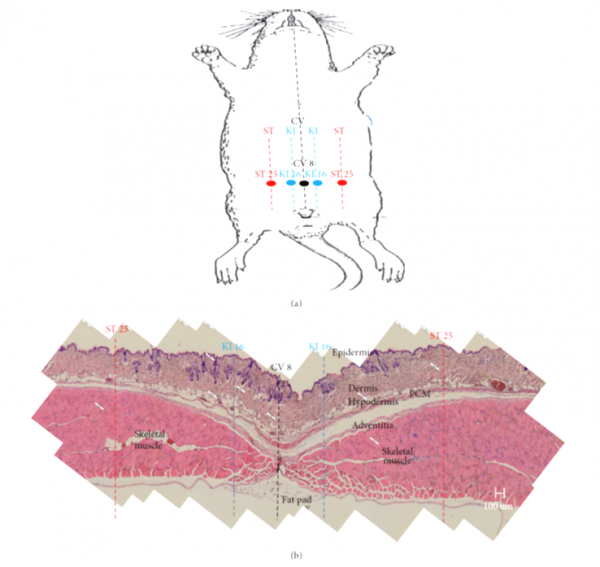
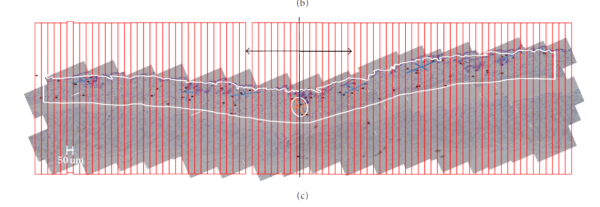
- Jung SJ, Song H, Kim YY, Kim J, Kim S, Song YK, Soh. Distribution of Mast Cells and Locations, Depths, and Sizes of the Putative Acupoints CV 8 and KI 16 Evid Based Complement Alternat Med. 2017. [194808].
The anatomical locations and sizes of acupuncture points (APs) are identified in traditional Chinese medicine by using the cun measurement method. More precise knowledge of those locations and sizes to submillimeter precision, along with their cytological characterizations, would provide significant contributions both to scientific investigations and to precise control of the practice of acupuncture. Over recent decades, researchers have come to realize that Aps in the skin of rats and humans have more mast cells (MCs) than neighboring nonacupoints. In this work, the distribution of MCs in the ventral skin of mice was studied so that it could be used to infer the locations, depths from the epidermis, and sizes of three putative Aps. The umbilicus was taken as the reference point, and a transversal cross section through it was studied. The harvested skins from 8-week-old mice were stained with toluidine blue, and the MCs were recognized by their red-purple stains and their metachromatic granules. The three putative Aps, CV 8 and the left and the right KI 16 Aps, were identified based on their high densities of MCs. These findings also imply that acupuncture may stimulate, through MCs, an immune response to allergic inflammation.