Sommaire
5TR Waiguan 外关 (外關)

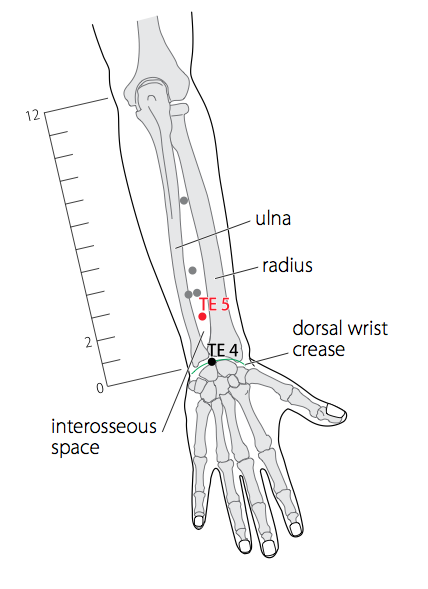
1. Dénomination
1.1. Traduction
| 外关 wàiguān | Barrière externe (Nguyen Van Nghi 1971, Pan 1993, Lade 1994, Laurent 2000) |
|---|
- Zhou Mei-sheng 1984 : wai the lateral side of the forearm. guan passage; block.
- Wai (Ricci 5436) : dehors, extérieur, étranger (Guillaume 1995); dehors, au dehors, hors de, en dehors, extérieur… Cf. wailing 26E (Laurent 2000)
- Guan (Ricci 2788) : barre de bois servant à fermer la porte ; fermer, clore, obstruer, boucher ; barrière, poste frontière, passe, défilé, douane, clé, organes vitaux ; concerner, mettre en rapport (Guillaume 1995); fermer, clore, obstruer, barrière, passe… Cf. xiaguan 7E (Laurent 2000)
1.2. Origine
- Ling shu, chapitre « Jing mai ». (Guillaume 1995)
1.3. Explication du nom
- Zhou Mei-sheng 1984 : waiguan The point is at the communications hub on the lateral side of the forearm. It corresponds to Neiguan(6MC). It is an important place for the interconnection between Hand Shaoyang and Hand Jueyin
- Pan 1993 : wai: extérieur ; Guan: passe de montagne, passage important. Passage important pour communiquer avec l'extérieur. Neiguan (6MC) est en communication avec le Vaisseau merveilleux Yinweimai; il traite les maladies de certains Zangfu, qui sont « à l'intérieur ». Le waiguan, au contraire, est situé du côté externe, côté Yang, de l'avant-bras. Il est en communication avec le Vaisseau merveilleux Yangweimai et traite les maladies « externes », celles des épaules et du cou, par exemple. C'est pourquoi, par opposition à neiguan, il est appelé waiguan ou « Passage important pour communiquer avec l'extérieur ».
- Lade 1994 : le nom fait référence au rôle de ce point en tant que voie de passage ou de Communication avec le méridien du Maître-du-Cœur et le Vaisseau de Liaison du Yang. Externe fait référence à la face externe de l'avant-bras et à la localisation du point sur un méridien Yang. Ce point est le complément de MC6 (nei guan), Barrière Interne.
- Laurent 2000 : Beaucoup de commentateurs se contentent de dire que le point est situé sur la partie externe du bras (lorsqu'il est le long du corps). Wai est le terme utilisé dans l'expression nei/wai (interne/externe), waiguan est le point “clé” du Yangwei mai, vaisseau curieux qui gère la superficie du corps, on le compare le plus souvent à un réseau qui relie les méridiens dans le Yang et plus particulièrement : Zushaoyang et Zutaiyang. Guan peut, dans ce contexte, se traduire par : 1) passe si l'on considère la position du point entre radius et cubitus, 2) barrière si l'on privilégie le sens de protection de l'externe, 3) obstruction si l'on se rapporte à la pathologie (lorsqu'une perversité froid pénètre la peau elle entraîne la fermeture des pores de la peau ce qui entrave son rejet par l'organisme, waiguan en agissant sur l'ouverture des pores favorise la sortie de la perversité).
1.4. Noms secondaires
| Yáng wěi xué 阳维穴[陽維穴] (1) | Zhen jing zhi nan (Guillaume 1995) |
- Du nom du méridien curieux dont il est le point clé Yang (Ricci 5650) : du couple Yin-Yang ; Wei (Ricci 5512) : fibre, filament ; lier, attacher, joindre, unir ; principe fondamental ; maintenir, sauvegarder, préserver ; Xue (Ricci 2101) : habitation creusée dans la terre, caverne, grotte, cavité, trou, tanière.
1.5. Translittérations
- (fra)
- (eng)
- (viet)
1.6. Code alphanumérique
TR5, 5 TR, 5 TF, TE 5
2. Localisation
2.1. Textes modernes
- Nguyen Van Nghi 1971 : A deux distances au-dessus du pli postérieur du poignet, où se trouve le Tang Tcheu (4TR) à la face postérieure de l'avant-bras ; entre le radius et le cubitus, exactement à l'opposé de Nei Koann (6MC).
- Roustan 1979 : A deux distances au-dessus du milieu du pli dorsal du poignet, entre radius et cubitus.
- Pan 1993 : Le point Waiguan se trouve à 2 distances au-dessus du pli dorsal du poignet, à l'opposé du point Neiguan (6MC), qui se trouve aussi à 2 distances au-dessus du poignet, mais du côté interne, côté Yin.
- Deng 1993 : Sur le dos de l'avant-bras, sur une ligne reliant Yangchi (4TR) et la pointe du coude, à 2 cun en arrière du pli dorsal du poignet, entre le radius et le cubitus.
- Guillaume 1995 : À 2 distances au-dessus du milieu du sillon transverse dorsal du poignet, entre le radius et le cubitus.
- Laurent 2000 : Sur la face postérieure de l'avant-bras, à 2 cun au-dessus du pli postérieur du poignet, entre cubitus et radius, sur une ligne reliant yangchi 4TR à la pointe de l'olécrâne.
- Who : On the posterior aspect of the forearm, midpoint of the interosseous space between the radius and the ulna, 2 B-cun proximal to the dorsal wrist crease. Note: 2 B-cun proximal to TE4, in the depression between the radius and the ulna.
Items de localisation
2.2. Textes classiques
- Deng 1993 : 1) “A 2 cun au-dessus du poignet.” (Ling Shu) 2) “Dans la dépression située à 2 cun au-dessus du poignet” (Jia Yi) 3) “A 2 cun au-dessus du poignet, entre les deux tendons, à 2 cun au-dessus de Yangchi (4TR)” (Ju Ying) 4) “A 2 cun au-dessus du poignet, entre les deux os, à l'opposé de Neiguan (MC6).” (Da Cheng). Remarque : La plupart des anciens ouvrages de médecine s'accordent sur la localisation de ce point et le situent à 2 cun au-dessus du poignet. A la place de “entre les deux tendons”, il faut lire “entre les deux os”. Actuellement, on situe Waiguan (5TR) sur le dos de l'avant-bras et sur une ligne reliant Yangchi (4TR) au sommet de l'olécrane, à 2 cun au-dessus du pli dorsal du poignet, entre le radius et le cubitus. La définition de Ju Ying se contredit elle-même.
2.3. Rapports et coupes anatomiques
- Roustan 1979 : Nerf cutaneus antebrachii lateralis, nerf interosseus antebrachial posterior.
- Guillaume 1995 : Artères interosseuses antérieure et postérieure. Branche cutanée antébrachiale dorsale du nerf radial, branche profonde du nerf radial.
2.4. Rapports ponctuels
3. Classes et fonctions
3.1. Classe ponctuelle
- Nguyen Van Nghi 1971 : Point Lo du méridien d'où partent les vaisseaux Lo. Le Lo transversal communique avec le point Iu- Iunn du méridien principal du Maître du Cœur (Taé Ling, 7MC). Point d'ouverture du méridien curieux Iang Oé. Nei King (Chapitre 66) : « Quand l'énergie perverse (vent froid, chaleur…) attaque l'homme…, si elle se loge dans les méridiens, ceux-ci seront obstrués et on le verra aux points Lo : Nei Koann (6MC), Oé Koann (5TR), Trong Li (5C), Li Tsiue (7P), Tche Tcheng (7IG) et Penn Li (6GI). »
- Roustan 1979, Laurent 2000 : Waiguan (Oaé Koann) ; 1) Point Luo de Shoushaoyang. 2) Point clé : stimule le Yangwei.
- Guillaume 1995 : Il s'agit du point luo du méridien Shoushaoyang. C'est un des point clés des huit méridiens curieux. Il communique avec Yangweimai.


3.2. Classe thérapeutique
- Guillaume 1995 : Waiguan disperse le vent, libère le Biao, purifie la chaleur, neutralise les toxiques, perméabilise les méridiens Jing luo. Selon le Tai yi shen zhen, Waiguan élimine tous les symptômes du Biao dus au Qi pervers des six débordements-liu yin (vent, froid, canicule, humidité, sécheresse, Feu).
- Laurent 2000 : Ouvre le Yangweimai, disperse la perversité Yang située en superficie, élimine la chaleur, calme le vent, traite jing feng (convulsions infantiles), fait circuler l'énergie du méridien et les Luo. Traite les symptômes de la branche Luo Plénitude : contractures du coude, Vide : relâchement du coude.
4. Techniques de stimulation
| Acupuncture | Moxibustion | Source |
|---|---|---|
| Selon Tong ren, puncturer à 0,3 distance, laisser l'aiguille le temps de 7 expirations | Selon Tong ren appliquer 2 cônes de moxa ; 3 cônes, selon Ming tang | Zhen jiu ju ying (Guillaume 1995) |
| Piquer à 1-1,5 distance (1) Piquer obliquement vers le haut à 1,5-2 distances (2) | Cautériser 3-5 fois, chauffer 5-15 minutes | Roustan 1979 |
| Puncture perpendiculaire entre 0,5 et 1 distance de profondeur | Cautérisation avec 3 à 5 cônes de moxa, moxibustion pendant 5 à 10 minutes | Guillaume 1995 |
| Piqûre perpendiculaire de 0,5 à 1 cun | Moxas 3 à 7 | Laurent 2000 |
Sensation de puncture
- sensation de gonflement qui diffuse parfois vers l'extrémité des doigts
- sensation de gonflement qui diffuse vers le haut
Sécurité
5. Indications
| Usage : Point référencé nomenclature OMS ( WHO 1991) Point usuel - secondaire (Roustan 1979) |
5.1. Littérature moderne
- Nguyen Van Nghi 1971 : Point à puncturer spécialement dans les cas de : céphalées, bourdonnements, surdité, fièvre, arthralgie du membre supérieur, paralysie, torticolis.
- Roustan 1979 : Grippe, fièvre élevée, pneumonie, oreillons, surdité, bourdonnements d'oreille, migraine, pertes d'urines, torticolis, douleurs articulaires des membres supérieurs. Autres indications : douleurs digitales, tremblement des doigts, maladies fébriles.
- Lade 1994 :
- Régularise le Triple Réchauffeur et le Vaisseau de Liaison du Yang, soulage les maladies externes, clarifie la Chaleur, tonifie le Qi Protecteur, disperse le Vent et le Vent-Chaleur, fortifie et décontracte les tendons, et soulage la douleur. Indications : maladies fébriles, pneumonie, oreillons, obstruction douloureuse de type Vent prédominant, névralgie du trijumeau due au Vent-Chaleur, syndrome atrophique de la partie haute du corps, hypertension, paralysie infantile, hémiplégie, convulsions, rhume avec fièvre, fièvre et frissons en alternance, céphalée unilatérale ou occipitale, raideur de la nuque, nausées, vomissements, surdité, acouphènes, douleur de la poitrine et de l'hypochondre, douleur et raideur de l'épaule, sévère douleur abdominale avec crampes, et incontinence urinaire.
- Effet local : engourdissement, contracture ou douleur de l'avant-bras, du poignet ou des doigts, et tremblements de la main.
- Guillaume 1995 : Maladies de la chaleur, céphalée, bourdonnement d'oreille, surdité, rougeur des yeux, raideur de la nuque, douleur des flancs, adénites, douleur du bras, du coude et des doigts, tremblement des mains ; grippe, pneumonie, parotidite.
5.2. Littérature ancienne
- Ling shu : Chapitre « Jing mai » : « En cas de plénitude : contracture du coude ; en cas de vide : relâchement et impotence du coude » (Guillaume 1995).
- Jia yi jing : « Bourdonnements d'oreille avec surdité », « Trismus et déviation de la bouche », « Douleur du coude et de la face interne du bras, impossibilité de porter la main à la tête » (Guillaume 1995).
- Qian yao fang « Atrophie-wei du bras avec parésie-buren » (Guillaume 1995).
- Ishimpo : Enflure du coude ; bourdonnements d'oreille ; douleur sous le bras, sécheresse de la bouche et trismus (Guillaume 1995).
- Sheng hui Fang : « Endolorissement, lourdeur du coude et du poignet avec difficulté de flexion-extension, douleur des dix doigts et impossibilité de les serrer » (Guillaume 1995).
- Zhen jiu da quan : « Enflure, rougeur du bras et de l'épaule avec douleur de l'articulation », « Douleur articulaire des doigts avec impossibilité de les fléchir et de les étendre », « Rougeur, enflure et douleur de la malléole interne », « Douleur articulaire des orteils », « Épistaxis incessante », « Vomissement de sang avec vertige et perte de connaissance », « Raideur de la langue avec difficulté d'élocution », « Aphtes buccaux », « Lèvres fissurées », « Adénites cervicales », « Enflure, rougeur et douleur de la racine des oreilles », « Enflure et rougeur chroniques du cou », « Ptérygions », « Blépharite, conjonctivite avec larmoiement au vent », « vent des yeux avec enflure douloureuse et ptérygions », « Enflure douloureuse des joues et odontalgie », « Surdité », « Bourdonnement ou prurit ou douleur des oreilles »; « Bruit de tonnerre dans la tête avec vertige de type vent, émission de glaires-tan et de salive-xian par la bouche », « Vide de Rein avec céphalée », « Jue des glaires-tan lue avec vertige », « Douleur du vertex », « Rougeur des yeux avec gonflement brutal et douleur » (Guillaume 1995).
- Yu long jing : « Accès de fièvre avec crainte du vent, douleur des cent articulations, plénitude du thorax avec contracture, attaque directe par le vent- feng avec hémiplégie, contracture des lombes et des membres inférieurs, paresthésies tenaces des mains et des pieds qui sont froids et douloureux, vent de la tête uni ou bilatéral, douleur oculaire et larmoiement au vent » (Guillaume 1995).
- Jie jing : « Rougeur et douleur du membre supérieur et de l'épaule, arthralgies, enflure, rougeur et douleur de la malléole interne, douleur des articulations des doigts et des orteils avec impossibilité de les fléchir et de les étendre, nouure de la chaleur-jie re dans les Cinq Organes et les Six Entrailles, vomissement de sang dû à la circulation désordonnée qui ne cesse pas, épistaxis continuelle, vomissement de sang avec lipothymie-vertige, perte de connaissance, vide et blessure par reflux du Qi-xu sun qi ni. En cas d'excès de Yang par rapport au Yin, le Sang est chaud et circule de manière désordonnée ; lorsque le Yin est en excès par rapport au Yang, le Sang est froid avec vomissements, cela s'appelle vomissement de sang en relation avec les méridiens xin- Cœur et fei-Poumon. Raideur de langue avec difficulté d'élocution, enduit de la langue blanc, pesanteur et enflure de la langue, aphtes par excès de chaleur, protrusion ou rétraction de la langue avec impossibilité de parler, fissures des commissures labiales avec saignement, sécheresse et douleur ; adénites cervicales tuberculeuses-lei douleur et enflure de la racine de l'oreille et du cou, ptérygions, rugosité des yeux avec difficulté à les ouvrir, larmoiement au vent, vent des yeux avec enflure douloureuse, excroissance charnue avec rougeur brutale et enflure douloureuse de l'œil. Dans tous ces tableaux, il faut d'abord puncturer Waiguan - 5TR puis associer d'autres points en fonction des symptômes » (Guillaume 1995).
- Zhen jiu ju ying : surdité, douleur des cinq doigts avec difficulté à saisir un objet. Contracture du coude en cas de plénitude, il faut disperser. Relâchement en cas de vide, il faut tonifier » (Guillaume 1995).
- Yi xue ru men : « Lourdeur, douleur du coude et du poignet avec difficulté de flexion-extension, douleur des doigts, surdité, impotence fonctionnelle du bras avec atrophie » (Guillaume 1995).
- Da cheng : « Surdité, douleur des cinq doigts avec difficulté à saisir un objet. Contracture du coude en cas de plénitude, il faut disperser. Relâchement en cas de vide, il faut tonifier. Ce point traite aussi les difficultés à fléchir et à étendre le bras » (Guillaume 1995).
- Lei jing tu yi : « Surdité avec bourdonnements d'oreille, douleur du coude, de l'avant-bras et des cinq doigts avec impossibilité de saisir un objet, appliquer 7 cônes de moxa » (Guillaume 1995).
- Yi zong jin jian : « Nouure de la chaleur-lie re au niveau des Cinq Organes et des Six Entrailles, épistaxis, vomissement de sang qui ne cesse pas », « Adénites tuberculeuses-lei li qui enserrent le cou et descendent jusqu'au thorax avec enflure douloureuse qui ne se dissipe pas » (Guillaume 1995).
- Tai yi shen zhen : « Surdité, bourdonnements d'oreille, douleur du bras, du coude et des cinq doigts avec difficulté de préhension, céphalée, fièvre » (Guillaume 1995).
5.3. Associations
| Indication | Association | Source |
|---|---|---|
| Constipation et les douleurs abdominales | 5TR + 7MC + 6TR | Yu long Fu (Guillaume 1995 |
| Bourdonnements d'oreille et surdité | 5TR + 7TR | Qian jin (Guillaume 1995) |
| Déviation de la bouche et trismus | 5TR + 44E + 36E + 9P + 5Rte | Qian jin (Guillaume 1995) |
| Surdité | 5TR + 2VB | Zi sheng jing (Guillaume 1995) |
| Douleur de la tête et des yeux | 5TR + 3IG | Shen jiu jin lun (Guillaume 1995) |
| Parotidite | 5TR + 7TR + 6E + 11GI + 4GI | Zhong guo zhen jiu xue gai yao (Guillaume 1995) |
| Grippe avec fièvre | 5TR + 14VG + 11GI + 4GI | Zhen jiu xue jian bian (Guillaume 1995) |
| Douleur du poignet | 5TR + 6MC + 6IG | Shanghai zhen jiu xue (Guillaume 1995) |
| Grippe | 5TR + 20VG + 4GI + 7P | Shanghai zhen jiu xue (Guillaume 1995) |
| Douleur du poignet | 5TR vers 6MC + 6IG | Roustan 1979 |
| Grippe | 5TR + 20VG + 4GI + 7P | Roustan 1979 |
5.4. Revues des indications
- Zhang Di Fen. L'application clinique du couple de points : Wai Guan (5 T.R.) et Zu Lin Qi (41 V.B.). Acupuncture Traditionnelle Chinoise.2005.13:61. [126257]
6. Etudes cliniques et expérimentales
6.1. Electromyographie des muscles faciaux
- Chen T, Cai DJ, Zhou QZ, Wang XL, Yang HQ, Yang LC, Liu XG. [Impacts of acupuncture at hegu (li 4) on facial emg in rhesus monkeys under the physiological state]. Chinese Acupuncture and Moxibustion. 2013. 33(3):241-6. [162609].
OBJECTIVE: To observe the specificity relationship between acupuncture at “Hegu” (LI 4) and the facial muscular movement in rhesus monkeys under the physiological state by using neuromuscular electrical measurement technique. METHODS: Eighteen rhesus monkeys were randomized into a Hegu group, a Houxi group and a Waiguan group, 6 monkeys in each one. Under the physiological state, EMG was detected on the frontal muscle, zygomatic muscle and orbicular muscle before and after acupuncture at different acupoints. The impacts of acupuncture on the facial EMG were studied and compared among different acupoints. RESULTS: With acupuncture at “Hegu” (LI 4), the latency was reduced (P < 0.01) and the peak value and area were increased (P < 0.05, P < 0.01) in the frontal EMG; the area and the peak value were increased (P < 0.01, P < 0.05) and latency was reduced (P < 0.05) in the zygomatic EMG; the frequency was increased (P < 0.01) and the latency was reduced (P < 0.05) in the orbicular EMG. Before and after acupuncture at “Hegu” (LI 4), the change rates of EMG frequency, peak value, area and latency on the frontal, zygomatic and orbicular muscles were higher than those at “Houxi” (SI 3) and “Waiguan” (TE 5) (P < 0.05, P < 0.01) separately. CONCLUSION: The relative specificity presents between Hegu (LI 4) and facial muscular movement.
6.2. Asthme
- Lewis GBH et al. Acupuncture at Points Yangchi and Waiguan Compared with the Established Points Feishu and Dazhui in the Therapy of Asthma. American Journal of Acupuncture. 1993;21(3):241-5. [57190].
In this study two acupoints not traditionally prescribed for asthma, Yangchi (SJ 4), and Waiguan (SJ 5) were compared to the classically prescribed points Feishu (Bl 13) and Dazhui (GV 14). Respiratory parameters and acute ventilatory responses to acupuncture in 20 chronic asthmatic patients were assessed including respiratory frequency, tidal volume, peak inspiratory flow rate, etc. The results suggest that the Sanjiao points should be considered when choosing points for treating asthma. The author proposes possible explanations for the results from both the perspectives of traditional Chinese theory and Western physiology.