Sommaire
6Rte Sanyinjiao 三阴交 (三陰交)
prononciation 
| Articles connexes : - 5Rte - 7Rte - Méridien - |


1. Dénomination
1.1. Traduction
| 三阴交 sānyīnjiāo | Réunion des trois inn (Soulié de Morant 1934, Nguyen Van Nghi 1971) Croisée des trois Yin (Pan 1993) Croisement des trois Yin (Laurent 2000) | Crossroad of three yin (Li Ding 1992) |
|---|
- Zhou Mei-sheng 1984: san three yin yin Meridian of foot Sanyin three Yin, Meridians of Foot jiao meet
- Guillaume 1995 : San (Ricci 4196) : trois.Yin (Ricci 5789) : de Yin et Yang.Jiao (Ricci 585) : croisée, intersection, livrer, échanger ; mutuel ; entrer en contact, nouer des relations.
- san 三 trois
- yin 陰 (阴) yin de yin/yang
- jiao 交 rencontrer, se réunir
1.2. Origine
- Jia yi jing (Guillaume 1995)
1.3. Explication du nom
- Zhou Mei-sheng 1984: Sanyinjiao This point is the place where the Spleen Meridian of Foot Taiyin, the Kidney Meridian of Foot Shaoyin and the Liver Meridian of Foot Jueyin meet.
- Pan 1993 : C'est le point où se croisent les trois méridiens Yin du pied : le méridien Zutaiyin Rate, le méridien Zushaoyin Reins et le méridien Zujueyin Foie. D'où son nom : « Croisée des trois Yin ».
- Lade 1994 : Le nom fait référence au Croisement des trois méridiens Yin du pied au niveau de ce point.
- Laurent 2000 : San : le nombre 3, nombre des souffles à partir desquels sont formés les 10 000 êtres… Cf. 3GI sanjian. Yin : yin de Yin/Yang… Cf. 33E yinshi. Jiao : personnage assis jambes croisées (pacifiquement) avec qui l'on a des relations d'échange, ou deux personnages dont les jambes sont entremêlées comme lors de relation sexuelles, d'où : échanger, troquer, nouer des relations, entretenir de bons rapports, avoir des rapports sexuels, entrer en contact, contigu, se croiser, se couper, intersection, croisement, en même temps (événements qui se coupent dans un même temps). La distance de 3 cun justifie l'ancienne appellation sanli 3 distances. Sur ce point croisement des 3 méridiens Yin du bas on peut avoir une action sur Zujueyin, Zutaiyin, Zushaoyin ce qui justifie son nom.
1.4. Noms secondaires
Da yin, 大阴(大陰) cité par Zhen jiu jing xue tu kao (Guillaume 1995, Laurent 2000)
- Da (Ricci 4621) : grand, gros, important, adulte.
- Yin (Ricci 5789) : du couple Yin-Yang.
Cheng ming 承命 (assume la destinée), Taiyin 太陰(太阴) (Yin extrême), Xiasanli 下之三里 (Sanli inférieur), Xiazhisanli 下之三里 (Sanli du bas) (Laurent 2000).
1.5. Translittérations
- Sann inn tsiao (fra)
- San Yin-chiao (Li Su Huai 1976)
1.6. Code alphanumérique
- 6Rte, 6Rt, RA6 (Rate)
- SP6 (Spleen)
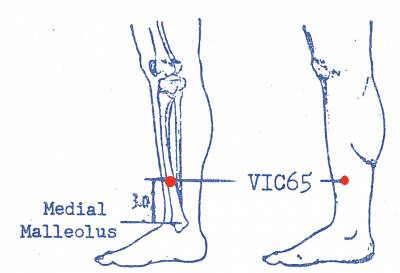
- VI-C65 (Li Su Huai 1976)
2. Localisation
2.1. Textes modernes
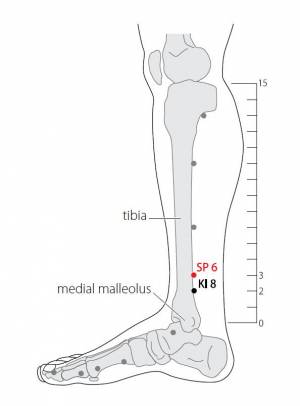
- Nguyen Van Nghi 1971 : A trois distances de la malléole interne, juste dans un creux du bord postéro-interne du tibia.
- Li Su Huai 1976 : 3.0 in. above the medial malleolus, at the posterior edge of the tibia. Bilateral.
- Roustan 1979 : Au bord postéro-interne du tibia, trois distances au-dessus du point le plus saillant de la malléole interne.
- Deng 1993 : Sur la face interne de la jambe, à 3 cun au-dessus de la pointe de la malléole interne, en arrière du bord interne du tibia.
- Pan 1993 : Sanyinjiao se trouve à 3 distances au-dessus du point le plus saillant de la malléole interne, au bord postéro-interne du tibia.
- Guillaume 1995 : à 3 distances au-dessus de la pointe de la malléole médiale, au bord postéro-médial du tibia.
- Laurent 2000 : À 3 cun au-dessus de la pointe de la malléole interne, au bord postéro-interne du tibia.
- WHO 2009 : On the tibial aspect of the leg, posterior to the medial border of the tibia, 3 B-cun superior to the prominence of the medial malleolus. Note: 1 B-cun superior to KI8.
2.2. Textes classiques
- Jia Yi Jing : “A 3 cun au-dessus de la malléole interne, dans la dépression située en arrière du tibia” (Deng 1993).
- Qian Jin : “A 8 cun au-dessus de la malléole interne, dans la dépression située en arrière du tibia.” (Deng 1993).
- Jin Jian : “A 3 cun au-dessus de la malléole interne, dans la dépression située en arrière du tibia.” (Deng 1993).
- Deng 1993 : Remarque: La plupart des ouvrages de médecine du passé indiquent que ce point se trouve “à 3 cun au-dessus de la malléole interne”. Actuellement, on le situe en arrière du bord interne du tibia, à 3 cun au-dessus du sommet de la malléole interne. La définition de Qian Jin “8 cun, au-dessus de la malléole interne”, a été rejetée après la dynastie des Song.
2.3. Rapports et coupes anatomiques
- Roustan 1979 : Veine saphena magna, artère et veine tibialis posterior, ramus cutaneus cruris medialis du nerf femoralis.
- Deng 1993 : Peau—tissu sous-cutané— muscle long fléchisseur des orteils—muscle jambier postérieur—muscle long fléchisseur du gros orteil. Dans la couche superficielle, on trouve les branches cutanées jambières internes du nerf saphène et les tributaires de la veine grande saphène. Dans la couche profonde, on trouve le nerf tibial et l'artère et la veine tibiales postérieures.
- Chen 1995 :
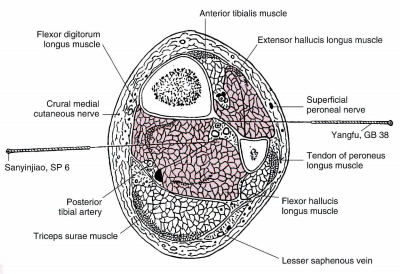 6Rte et 38VB coupe transversale (Chen 1995)
a. Skin: the branches from the saphenous nerve containing fibers from the fourth lumbar nerve (LA) innervate the skin. b. Subcutaneous tissue: includes the previously described skin nerve branches and the greater saphenous vein. c. Flexor digitorum longus muscle: the branches from the tibial nerve containing fibers from the fifth lumbar and first sacral nerves (L5, S1) innervate the muscle. d. Posterior tibialis muscle: the branches from the tibial nerve containing fibers from the fifth lumbar and first sacral nerves (L5, S1) innervate the muscle. e. Flexor hallucis longus muscle: the muscle is located posterior and lateral to the posterior tibialis muscle. The branches from the tibial nerve containing fibers from the fifth lumbar and first sacral nerves (L5, S1) innervate the muscle. f. If the needle is inserted perpendicularly, it will be passed through the flexor digitorum longus, flexor hallucis longus and soleus muscles, tibial artery and tibial vein, then through the interosseous membrane to the extensor hallucis longus and extensor digitorum longus muscles, and anterior tibial bone to the subcutaneous tissue. g. If the needle is inserted in a posterior oblique direction, it can puncture the posterior tibial artery and vein, and the tibial nerve. h. If the needle is inserted in an inferior oblique direction, it will be passed into the flexor digitorum longus and posterior tibialis muscles.
- Guillaume 1995 : Grande veine saphène, artère et veine tibiales postérieures. Nerf saphène et nerf tibial.

2.4. Rapports ponctuels
| 5F | 7Rte | 9Rn |
|
| | ↑ ← 6Rte → ↓ | ||
|---|---|---|---|
| 8Rn | 7Rn | ||
| avant | côté droit face interne | arrière | |

De bas en haut et d'avant en arrière : 1Rte Yinbai; 2Rte Dadu; 3Rte Taibai; 4Rte Gongsun; 2Rn Rangu; 4F Zhongfeng; 5Rte Shangqiu; 6Rn Zhaohai; 5Rn Shuiquan; 4Rn Dazhong; 3Rn Taixi; 8Rn Jiaoxin; 7Rn Fuliu; 6Rte Sanyinjiao; 5F Ligou; 9Rn Zhubin; 7Rte Lougu; 6F Zhongdu; 8Rte Diji; 9Rte Yinlingquan; 7F Xiguan;8F Ququan; 10Rn Yingu (Deng 1993)
3. Classes et fonctions
3.1. Classe ponctuelle
- Nguyen Van Nghi 1971 : Point de croisement des trois méridiens principaux Inn du Pied (Rate, Reins, Foie).
- Point de réunion des trois Zu (Roustan 1979, Guillaume 1995).
- Point de croisement des 3 méridiens Yin du bas (Laurent 2000).
3.2. Classe thérapeutique
- Traite la rate, élimine l'humidité, tonifie le rein (Roustan 1979).
- Sanyinjiao tonifie la Rate-Estomac, perméabilise les Jing luo, harmonise le Souffle et le Sang, calme le Shen. Selon le Tai yi shen zhen, Sanyinjiao tonifie la Rate et nourrit le Yin ; régularise les méridiens-et-vivifie le Sang, lève les stagnations de Sang (Guillaume 1995).
- Réunion des 3 zuyin, tonifie le sang, traite les problèmes du petit bassin, tonifie la rate qui renforce le qi du Poumon, renforce Rate et Estomac, favorise le “transport/transformation”, régularise les jing et les luo, élimine l'humidité, tonifie le Rein (Laurent 2000).
4. Techniques de stimulation
| Acupuncture | Moxibustion | Source |
|---|---|---|
| Needle perpendicularly 1.0-2.0 in. | Moxa stick 5-10 min. 3-7 moxa cones | Li Su Huai 1976 |
| 1) Piquer perpendiculairement à 1,5-2 distances; 2) Perpendiculairement à la peau et légèrement vers le bas, à 1-1,5 distance 3) Obliquement à 1,5-2,5 distances vers le haut | Chauffer 10-20 minutes, cautériser 3-7 fois | Roustan 1979 |
| Puncturer à 0,3 distance (Tong ren) | Appliquer 3 cônes de moxa (Tong ren) | Zhen jiu ju ying (Guillaume 1995) |
| Puncture perpendiculaire entre 1 et 1,5 distance de profondeur | Cautérisation avec 5 à 10 cônes de moxa, moxibustion pendant 10 à 20 minutes | Guillaume 1995 |
| Piqûre perpendiculaire de 1 à 1,5 cun | Moxas : 3 à 5 ; chauffer 20 mn | Laurent 2000 |
Sensation de puncture
- Roustan 1979 : sensation de gonflement punture perpendiculaire) ou de décharge électrique irradiant à la plante du pied (puncture vers le bas) ; la sensation peut irradier jusqu'à la cuisse (puncture vers le haut)
Sécurité
- Lade 1994 : Puncture contre-indiquée pendant la grossesse.
- Tong ren précise qu'il est interdit de le puncturer pendant la grossesse (Guillaume 1995).
- Zheng Jinsheng. Two stories about acupuncture. International Journal of Clinical Acupuncture. 1992;3(1):95-6. [84389].
5. Indications
| Classe d'usage | ★★ | point essentiel |
|---|
5.1. Littérature moderne
- Nguyen Van Nghi 1971 : Point à puncturer spécialement dans les cas de : plénitude à la poitrine et au ventre, douleur au scrotum, absence de règles ou règles irrégulières, dysurie, énurésie, éjaculation précoce, asthénie mentale. Ne jamais puncturer ce point chez les femmes enceintes, à cause de la concentration des Inn.
- Li Su Huai 1976 : Diseases of the urinogenital organs, lower abdominal pain, diarrhea, exzema, neuro-dermatitis, urticaria, insomnia, dyspepsia, hemiplegia, menstrual pain, prolapse of uterus, seminal emission.
- Roustan 1979 : Affections uro-génitales, gonflement du ventre, douleur abdominale, diarrhée, paralysie, neurasthénie, eczéma, urticaire. Borborygmes, dyspepsie, règles anormales, leucorrhée, aménorrhée, accouchement difficile, vertige, spermatorrhée, pertes d'urines, hernie.
- Lade 1994 :
- Régularise, fortifie et tonifie la Rate (surtout le Qi et le Yang), régularise l'Estomac (surtout le Qi) et les Réchauffeurs Moyen et Inférieur, réduit les stagnations digestives, tonifie le Qi et le Sang, nourrit la Sécheresse du Sang, facilite la circulation du Sang, clarifie le Feu vide. Indications : hyperthyroïdie, pancréatite, entérite, insomnie, œdème, transpirations nocturnes ou spontanées, éblouissements et vertiges par vide de Qi et de Sang, asthénie des membres, maladie Qi de la jambe, plénitude et distension de la partie basse de l'abdomen, flatulences, et selles molles ou diarrhée chroniques avec douleur abdominale.
- Résout l'Humidité et la Chaleur-Humidité (surtout de la Rate et de l'Estomac) et assèche l'Humidité et le Froid-Humidité. Indications : troubles dysentériques dus au Froid-Humidité, hépatite, eczéma, urticaire, infection des voies urinaires par Chaleur-Humidité, urines troubles, et leucorrhées.
- Tonifie les Reins (surtout le Yin) et l'Essence, stabilise le Qi des Reins, enrichit le Yin, régularise la Voie des Eaux, favorise la miction, et humecte la Sécheresse. Indications : hypertension par vide de Yin des Reins, strangurie, néphrite, prostatite, impuissance, stérilité, neurasthénie, coliques néphrétiques, infection des voies urinaires, incontinence ou rétention d'urine, spermatorrhée ou règles irrégulières par tuberculose pulmonaire, insomnie, amaigrissement et faiblesse, et douleur lombaire et du genou.
- Régularise les menstruations, réchauffe le Froid, vivifie le Sang, rafraîchit la Chaleur du Sang, active le travail, et calme le fœtus. Indications : tous les types de saignements, en particulier saignements utérins anormaux, avortement de fœtus mort, agitation du fœtus par vide, gastralgie par stagnation de Sang, syndrome ménopausique, aménorrhée, dysménorrhée, nausées de la grossesse, travail difficile, et rétention placentaire.
- Régularise le Foie (surtout le Yin), soumet le Yang du Foie, et régularise le Qi. Indications : hystérie avec rires et pleurs soudains, orchite ourlienne, règles irrégulières, faiblesse généralisée, et éblouissements.
- Élève le Qi Médian. Indications : prolapsus des organes de la région abdominale, en particulier troubles herniaires et prolapsus utérin.
- Ramollit les masses dures. Indications : dilatation de la rate, cirrhose du foie, scrofule, lymphadénite inguinale, masses et tumeurs dures de l'abdomen.
- Effet local : douleur des membres inférieurs, atrophie musculaire, paralysie et troubles moteurs et douleur de la face médiale de la cheville.
- Guillaume 1995 : Borborygmes, ballonnement abdominal, diarrhée, indigestion, irrégularités menstruelles, méno-métrorragies, leucorrhées, aménorrhée, stérilité, prolapsus de l'utérus, dystocies, mort fœtale in utero, stagnation des lochies dans le post-partum, vertiges de type Sang (post-hémorragique), spermatorrhée, impuissance, dysurie, incontinence urinaire, Qi herniaires-han qi, atrophie des jambes, enflure des pieds-jiao qi, insomnie ; les différentes affections de l'appareil uro-génital, gastrites et entérites aiguës ou chroniques, dépression nerveuse, urticaire, eczéma.
5.2. Littérature ancienne
- Jia yi jing : Chaleur sous le pied, douleur et impossibilité de s'asseoir longtemps, Bi de l'humidité avec impossibilité de marcher, Frayeurs nocturnes et insomnie (Guillaume 1995).
- Zhou hou fang : Diarrhée cholériforme d'apparition brutale qui débute par un refroidissement des extrémités (Guillaume 1995).
- Qian jin yi fang : Dystocie, ménorragie, présentation transverse, Luxation du maxillaire, Douleur des pieds. En cas de Pollution nocturne, chez l'homme ou chez la femme, Faire 5 moxas Qian jin yi fang (Guillaume 1995).
- Qian jin yao fang : Hernie inguino-scrotale, Pollution nocturne, Ménorragie et pertes blanches, Douleur de la Rate avec impossibilité de marcher, douleur cutanée du pied, Froid des jambes avec impossibilité de s'allonger. Toux avec reflux, surmenage par vide-xu lao, blessure par le froid, maladie de la tristesse, spasmes des tendons et douleur des os, toux avec reflux, diarrhée liquide, plénitude abdominale, Bi de la gorge, sensation de plénitude au niveau du cou, hémorroïdes, reflux de Qi, saignement hémorroïdaire, sensation de pesanteur au niveau de la région génitale, épistaxis, furoncles des os (ostéite), difficulté de défécation et de miction, sécheresse du nez, sensation de plénitude épigastrique-fan man, accès de folie-kuang yi, marche désordonnée-zou qi (agitation). Dans ces 22 maladies, il convient de faire des moxas (Guillaume 1995).
- Qian jin yi fang : Dans les pollutions nocturnes chroniques, ce point est efficace. Il traite également les diarrhées cholériformes avec refroidissement des extrémités : il faut faire 7 moxas ; à répéter en cas d'échec. Dans les Lao lin, faire 100 moxas. Dans les hémorroïdes, puncturer à 0,3 distance de profondeur ; il traite également les difficultés de défécation. Hernie inguino-scrotale de Qi et d'Eau-qi dui et shui dui qui monte et descend, faire un nombre de moxas en fonction de l'âge (Guillaume 1995).
- Wai tai mi yao : Maladies de la Rate avec pesanteur du corps comparable à une sensation de faim, atrophie des pieds, impossibilité de marcher, convulsions-chi, douleur de la plante des pieds. En cas de vide : ballonnement abdominal, borborygmes, diarrhée et indigestion (Guillaume 1995).
- Ishimpo : Chaleur sous les pieds ; douleur de la jambe et impossibilité de se tenir debout ; paralysie rhumatismale et impossibilité de marcher (Guillaume 1995).
- Tong ren : Xian pi-accumulation avec froid dans l'abdomen (Guillaume 1995).
- Sheng ji : Écoulement uréthral, Vomissement avec refroidissement des extrémités (Guillaume 1995).
- Yu long jing : Les sept Shan, hernie inguino-scrotale, affections urinaires, les Cinq Lin (Guillaume 1995).
- Zhen jiu ju ying : état de vide et de faiblesse de la Rate-Estomac, plénitude et ballonnement épigastriques, inappétence, douleur de la Rate, lourdeur du corps, difficulté à lever les quatre membres, ballonnement avec borborygmes, diarrhée liquide, indigestion, masse intra abdominale-xian pi, froid de l'abdomen, douleur de la face interne du genou, dysurie, douleur de la verge, atrophie des pieds et impossibilité de marcher, douleur herniaire, égouttement urinaire, vide de la Vésicule, vomissement liquide post-prandial, pollution nocturne, diarrhée cholériforme et refroidissement des extrémités, impossibilité de bâiller avec luxation temporo-mandibulaire, impossibilité de fermer la bouche. Douleur de la verge et stimulation de l'organe originel-yuan zang (l'organe originel désigne le Rein où se trouvent le Yin et le Yang originels, stimulation de l'organe originel signifie apparition du désir sexuel chez l'homme), douleur intolérable de la région hypogastrique, convulsions-ke wu des enfants, amaigrissement de la femme lié à des rapports sexuels pendant les menstruations, masse intra-abdominale-zheng jia, méno-métrorragie incessante, agitation fœtale pendant la grossesse, présentation transverse et accouchement dystocique, rétention des lochies dans le post-partum, hémorragie abondante avec vertige et perte de connaissance. Lorsque les méridiens Jing mai sont obstrués et ne sont plus perméables, disperser Sanyinjiao et ils se perméabilisent. En cas de vide par consommation excessive de Qi et en l'absence de circulation du Qi, la tonification de ce point renforce les méridiens Jing mai qui deviennent perméables.
- Un prince de l'époque Song sort de son palais et rencontre une femme enceinte, il diagnostique qu'il s'agit d'une fille. Le médecin Wu Wenbo affirme qu'il s'agit d'un garçon et d'une fille. Le prince impatient veut en avoir confirmation immédiatement. Wenbo en dispersant Sanyinjiao-6Rt et tonifiant Hegu-4GI provoque l'accouchement et confirme le diagnostic. Ultérieurement, les gens considérèrent que la puncture de 6Rt et de 4GI était contre-indiquée chez la femme enceinte. Cependant, si Wenbo disperse le 6Rt et tonifie le 4GI pour provoquer l'avortement, pourquoi ne peut-on actuellement tonifier 6Rt et disperser 4GI pour protéger la grossesse? Le 6Rt est le point de réunion des trois Mai du Rein, du Foie et de la Rate, il contrôle le Sang-Yin, le Sang doit être tonifié et non pas dispersé ; le 4GI est le point yuan du Gros Intestin, le Gros Intestin est l'Entraille du Poumon qui contrôle le Qi, il doit être dispersé et non pas tonifié. Wenbo disperse le 6Rt et tonifie 4GI alors le Sang est en vide et le Qi en excès. En tonifiant le 6Rt et en dispersant le 4GI, le Sang est en excès et le Qi en insuffisance. C'est pour cette raison que Liu Yuanbin a aussi dit que si le Sang est en état de vide et le Qi en excès, il est certain qu'il n'y a pas de grossesse ; quand le Sang est en excès et le Qi en état de faiblesse, la femme doit être en état de gestation. » (Guillaume 1995).
- Yi xue ru men : « Douleur de la face interne du genou, miction difficile, lourdeur du corps avec atrophie des jambes, masse intra-abdominale-xian pi, froid de l'abdomen avec reflux du Qi, affections de la Rate avec impossibilité de mobiliser les quatre membres, ballonnement abdominal avec borborygmes, diarrhée liquide avec indigestion, méno-métrorragie » (Guillaume 1995).
- Da cheng : Reprend intégralement la citation du Zhen jiu ju ying (Guillaume 1995).
- Xun jing : « Ictère, œdème, vertiges en position debout avec parfois inclinaison du corps et tendance à tomber, convulsions-xian chi, diarrhée cholériforme, douleur et enflure de la face interne des genoux et des chevilles, furonculose et éruption maculeuse » (Guillaume 1995).
- Lei jing tu yi : « Faiblesse et vide de la Rate-Estomac, plénitude et ballonnement de la région thoraco-abdominale (épigastre), inappétence, maladie de la Rate avec sensation de pesanteur du corps, difficulté à mobiliser les quatre membres, présence d'aliments non digérés dans les selles, diarrhée glairo-sanguinolente, tuméfaction-xian pi avec douleur sous-ombilicale intolérable, attaque directe par le vent zhong feng avec perte de connaissance brutale, douleur de la face interne du genou, atrophie de la jambe avec difficulté de marche. Chez la femme, en cas d'accouchement dystocique, de méno-métrorragies, de pertes blanches et rouges, il faut d'abord disperser puis tonifier. Dans le Qi herniaire-shan qi avec gros testicule unilatéral douloureux et œdématié, les dysuries, le gonflement de tout le corps, il faut d'abord tonifier puis disperser » (Guillaume 1995).
- Wai ke da cheng : « Genou de la grue-he xi, furoncles de la région inguinale » (Guillaume 1995).
- Tai yi shen zhen : « Faiblesse de la Rate-Estomac, ballonnement plénitude de la région épigastrique, inappétence, lourdeur du corps, asthénie des membres, diarrhée, diarrhée glairo-sanguinolente, troubles menstruels, métrorragies, leucorrhée, aménorrhée, dysménorrhée, pollution nocturne, perte d'urine, insuffisance de Yin par surmenage, accouchements dystociques. C'est un des points majeurs en gynécologie et contre l'échappement de Yang soudain. C'est l'un des neuf points de rétablissement du Yang, il communique en haut avec les deux méridiens du Foie et du Poumon ; chaque fois qu'il y a tendance à l'épuisement du Yang dans les maladies brutales, on peut le puncturer pour traiter » (Guillaume 1995).
5.3. Associations
| Association | Source | |
|---|---|---|
| Artérite subaiguë | 6Rte + 12VC + 6MC + 36E | Roustan 1979 |
| Accouchement difficile | 6Rte + 4GI + 3F | Da Cheng (Roustan 1979, Guillaume 1995) |
| Œdème chronique du pied-jiao qi | 6Rte + 36E + 39VB | Yu long fa (Guillaume 1995) |
| Écoulement uréthral avec spermatorrhée chronique | 6Rte + 6VC | Bai zheng Fu (Guillaume 1995) |
| Toux due au froid | Tonifier 4GI et disperser 6Rte | Xi hong Fu (Guillaume 1995) |
| Douleur du pied, d'enflure du genou, paresthésies des orteils | 6Rte + 36E + 39VB + 4VB et 9Rte + 3F | Xi hong Fu (Guillaume 1995) |
| Maladie de la Rate-pi bing xue qi | 6Rte + 4GI | Tian xing bi que (Guillaume 1995) |
| Hernies du petit intestin | 6Rte + 1F | Qian kun sheng yi (Guillaume 1995) |
| Diarrhée | 6Rte + 9Rte | Jia yi jing (Guillaume 1995) |
| Entérite aiguë du nourrisson | 6Rte + 25E + 4GI | Xin zhen jiu xue (Guillaume 1995) |
| Phlébite post-thrombotique | 6Rte + 9Rte + 28V + 3VC | Shanghai zhen jiu xue (Guillaume 1995) |
5.4. Revues des indications
6. Etudes cliniques et expérimentales
6.1. Dysménorrhées
- Abaraogu UO, Igwe SE, Tabansi-Ochiogu CS. Effectiveness of SP6 (Sanyinjiao) acupressure for relief of primary dysmenorrhea symptoms: A systematic review with meta- and sensitivity analyses. Complement Ther Clin Pract. 2016;:92-105. [195747].
| Objective | We reviewed the available evidence for SP6 (Sanyinjiao) acupressure for the relief of primary dysmenorrhea (PD) symptoms, as well as patients' experiences of this intervention. |
|---|---|
| Methods | We searched six relevant databases and gray literature for publications dated up to March 2016. |
| Results | The search yielded 72 potential studies. Six of these studies, contributing a total of 461 participants, were included in this review. The primary outcome was pain intensity. Studies with significant homogeneity were pooled for meta-analysis. Qualitative data and quantitative data not suitable for meta-analysis were presented as a narrative synthesis. The Cochrane criteria demonstrated that the included studies were generally of low quality with a high risk of bias. SP6 acupressure delivered by trained personnel significantly decreased pain intensity immediately after the intervention (effect size = -0.718; CI = -0.951 to -0.585; p = 0.000), and pain relief remained up to 3 h after the intervention (effect size = -0.979; CI = -1.296 to 0.662; p = 0.000). However, patient-administered intervention required multiple monthly cycles to effect pain reduction. |
| Conclusion | SP6 acupressure appears to be effective when delivered by trained personnel for some PD symptoms. Findings suggest that self-administered acupressure shows promise for the alleviation of PD symptoms. High-quality research is needed before conclusive recommendations are proposed. |
- Chen MN, Chien LW, Liu CF. Acupuncture or Acupressure at the Sanyinjiao (SP6) Acupoint for the Treatment of Primary Dysmenorrhea: A Meta-Analysis. Evid Based Complement Alternat Med 2013:493038.[166862]
| Purpose | This meta-analysis aimed to evaluate the effectiveness of acupuncture or acupressure at the Sanyinjiao (SP6) acupoint in relieving pain associated with primary dysmenorrhea. |
|---|---|
| Methods | We searched the scientific literature databases to identify randomized controlled trials. The primary outcome was visual analogue scale (VAS) pain score. Three acupuncture and four acupressure trials were included in the meta-analyses. |
| Results | Three acupuncture and four acupressure trials were included in the meta-analyses. For the acupuncture analysis, there was no difference in themeanVAS score reduction between the SP6 acupoint and control (GB39 acupoint) groups (−4.935; lower limit = −15.757, upper limit = 5.887; 𝑃 = 0.371). For the acupressure analysis, there was a significant difference in the mean VAS score after intervention between the SP6 acupoint and control (rest/light touch at SP6/nonacupoint acupressure) groups, favoring the SP6 acupoint group (−1.011; lower limit = −1.622, upper limit = −0.400; 𝑃 =0.001). Sensitivity analyses demonstrated good reliability of the meta-analyses findings. |
| Conclusion | These findings suggest that acupuncture at SP6 is not more effective than acupuncture at an unrelated acupoint in the relief from primary dysmenorrhea. Acupressure at SP6 may be effective in the relief from primary dysmenorrhea. |
- Wang P, Zhang P, Wu GW, Hu SQ, Li J, Sun JJ, Wang YF, Zhao MY, Hu NJ, Zhu J. [Analgesic Effect of Deqi Induced by Needling at Sanyinjiao (SP 6) Acupoint on Primary Dysmenorrheal Patients with Cold Damp Stagnation Syndrome]. Acupuncture Research. 2018;43(1):49-55. [99722] .
OBJECTIVE: To observe the analgesic effect of deqi induced by needling at Sanyinjiao (SP 6) on primary dysmenorrheal (PD) patients with cold damp stagnation syndrome (CDSS). METHODS: A total of 64 PD patients with CDSS experiencing abdominal pain (≥40 mm in visual analogue scale ,VAS) were randomly assigned into deqi-expectation(DE) group(n=15) and no-deqi -expectation(NDE) group(n=49). On the first day of abdominal pain attack, bilateral SP 6 were punctured respectively with thicker needles with deeper insertion for deqi-expectation patients and thin filiform needles with shallow insertion for no-deqi-expectation patients. The needles were removed after 30 minutes, a deqi scale was used to evaluate the deqi condition. According to the results, patients in the DE group were further divided into deqi DE group and no-deqi DE group, patients in the NDE group were also divided into deqi NDE group and no-deqi NDE group. The VAS was used to evaluate the patients' abdominal pain severity before treatment and 0, 10, 20, 30 min after acupuncture needle withdrawal. RESULTS: The rate of deqi in the DE group was higher than that in the NDE group(P<0.05). The VAS scores of abdominal pain in the four groups were decreased at all time-points after needle withdrawal compared with those before treatment (P<0.01), while the VAS score in the deqi DE group were lower than in the no-deqi NDE group 30 min after needle withdrawal (P<0.05). CONCLUSION: The intervention method of thick needle, deep insertion and some manipulation is easier in inducing deqi than that of thin needle, shallow insertion and no manipulation. The analgesic effect of deqi is better than that of no-deqi for PD patients with CDSS.


- Xu LL, Zhang LF, Song XL, Ren XX, Li XH, Zhao YF, Guo MW, Sun ZF, Zhu J. [Comparative study on the analgesic effect of electroacupuncture at “sanyinjiao” (sp 6), “hegu” (li 4) and “xuehai” (sp 10) in dysmenorrhea rats]. Chinese Acupuncture and Moxibustion. 2010. 30(6):491-4. [155135].
OBJECTIVE: To observe and compare the analgesic effect of electroacupuncture (EA) at “Sanyinjiso” (SP 6), “Hegu” (LI 4) and “Xuehai” (SP 10) in dysmenorrhea rats so as to investigate the functional specificity of acupoint. METHODS: One hundred SD female rats aged three-month-old in the diestrus examined by the vaginal smear screening were randomly divided into a saline group, a model group, a Sanyinjiao (SF 6) group, a Hegu (LI 4) group and a Xuehai (Sp 10) group, 20 rats in each group. The rats in the last four groups were given Estradiol Benzoate combined with Oxytocin to prepare the models of dysmenorrhea and in the saline group were given the same dose of saline. Last three groups were treated with electroacupuncture (EA) at Sanyinjiao“ (Sp 6), “Hegu” (LI 4) and 'Xuehai” (SF 10) respectively. The writhing behaviors of the rats in each group were observed within 20 min performing electroacupuncture from the start of the pain and the waveforms of uterine contraction were recorded. RESULTS: In terms of the writhing behaviors, the writhing latency in the Hegu (LI 4) group was extended significantly (P < 0.05, P < 0.01) and the writhing numbers in the Hegu (LI 4) group were decreased significantly (both P < 0.05) as compared with those in the Sanyinjiao (SF 6) group and in the Xuehai (SF 10) group. In terms of the waveforms of uterine contraction, compared with that in the model group, the amplitude and the activity of uterine contraction in both Sanyinjiao (Sp 6) group and Hegu (LI 4) group were decreased significantly (all P < 0.05), and with no significant difference between the Xuehai (SF 10) and the model group (P > 0.05). CONCLUSION: For comprehensive assessment of the analgesic effect of electroacupuncture at different acupoints by using the writhing behaviors and the waveforms of uterine contraction, “Hegu” (LI 4) is the best, “Sanyinjiao” (SP 6) is the next and “Xuehai” (SP 10) is the third. showing a relatively functional specificity of the acupoint.
6.2. Insomnies
- Wang ZJ, Zhang Y, Guo W, Zhuang LX, Gao X, Willcox ML, Hu XY. Is single acupoint Sanyinjiao (SP 6) effective in managing insomnia? A systematic review of randomized controlled trials. Glob Health Med. 2020;2(4):212-220. [215592]. doi
| Background | Insomnia is a symptom of physical or mental disorder and refers to decreased sleep time and potentially low quality. There is evidence showing that acupuncture could enhance management of insomnia, and Sanyinjiao (SP 6) is one of the promising acupoints. This review aimed to evaluate the effectiveness of stimulating single acupoint SP 6 in managing insomnia. |
|---|---|
| Method | The study was registered under PROSPERO CRD42019140855. English and Chinese databases were searched for randomized controlled trials on single acupoint SP 6 stimulation in management of insomnia. Quality of methodology was assessed by two authors independently using the Cochrane Risk of Bias Tool, and reporting quality was assessed by the STRICTA checklist. The primary outcome was the Pittsburgh Sleep Quality Index (PSQI), and secondary outcomes were improvement in clinical effect and sleep duration assessed by polysomnogram (PSG). The extracted data were pooled and meta-analyzed with RevMan 5.3 software. |
| Results | Four trials involving 288 participants were included in this review. The findings showed that SP 6 stimulation could improve sleep quality (MD -0.30, 95% CI [-0.52, -0.08]), lengthen deep sleep duration (MD 80.46, 95% CI [56.47, 104.45]), rapid eye movement (REM) duration (MD 91.53, 95% CI [68.41, 114.65]), and increase improvement in clinical effect. Quality of reporting and methodology was limited in all included trials. |
| Conclusion | Some limited evidence showed that single acupoint stimulation of SP 6 could improve sleep quality, lengthen deep sleep and REM duration of patients with insomnia. However, the findings in this review should be interpreted with caution due to methodological limitations. |
6.3. Rétention urinaire
- Xudong G. Clinical Report on Treatment of Postoperative Urinary Retention with Acupuncture at “Four Liao” and Sanyinjiao Acupoints. American Journal of Acupuncture. 1994;22(4):349-51. [57242].
This study reports on twelve patients with postoperative urinary retention treated with acupuncture Utilizing acupoints Ciliao (BL-32) and Zhongliao (BL-33), bilaterally, combined with acupoint Sanyinjiao (SP-6). Treatment was effective and successful in the 12 patients (100%). The treatment methods are safe, easily mastered, effective and without side effects.
6.4. Induction du travail
- Yuan HW, Chen YR, Shu FZ, Li CH, Liu YQ, Ma LX, Ren XX, Zhang P, Li J, Xue LW, Xin SY, Zhu J. [Influence of Electroacupuncture Stimulation of Delivery-Facilitating Acupoints with Different Stimulating Parameters on Serum Endocrine Hormones of Late-Stage Pregnant Rats]. Acupuncture Research.2013.38(2):112-7. [167488].
OBJECTIVE: To observe the influence of electroacupuncture (EA) stimulation of “Hegu” (LI 4) and “Sanyinjiao”(SP 6; a classical delivery-facilitating acupoint recipe) at different parameters on endocrine hormone levels of late-stage pregnant rats, so as to find the better stimulation parameters for delivery facilitation. METHODS: Ninety-six female Wistar rats were randomly divided into eight groups: normal control (normal), pregnancy (model), EA-15 Hz, EA-30 Hz, EA-50 Hz, EA-2 Hz/ 15 Hz, EA-2 Hz/30 Hz and EA-2 Hz/50 Hz, with 12 rats in each group except EA-30 Hz group (n = 10). EA stimulation (0.2 to 0. 3 mA) was delivered to bilateral LI 4 for 20 min and then bilateral SP 6 for 5 min (25 min). The contents of serum estradiol (E2), progesterone (P) and prostaglandin E2 (PGE2) were detected by ELISA. RESULTS: Compared with the normal group, serum E2, P and PGE2 contents were significantly increased in the pregnancy model group (P<0.01), and E2/ P level was downregulated mildly (P>0.05). Compared with the model group, the contents of serum E2 in the EA-15 Hz, EA-30 Hz, EA-50 Hz, EA-2 Hz/15 Hz and EA-2 Hz/50 Hz groups, serum PGE2 contents in the EA-15 Hz, EA-30 Hz and EA-2 Hz/50 Hz groups, and E2/P levels in the EA-15 Hz, EA-30 Hz, EA-50 Hz and EA-2 Hz/50 Hz groups were significantly increased (P<0.01, P<0.05), whereas serum P contents in the EA-15 Hz, EA-30 Hz, EA-50 Hz and EA-2 Hz/50 Hz groups were significantly down-regulated (P<0. 01, P<0. 05). The effects of EA-2 Hz/50 Hz group were significantly superior to those of EA-2 Hz/15 Hz and EA-2 Hz/ 30 Hz groups in raising serum E2 and E2/P levels (P<0.05, P<0.01). No significant differences were found among the EA-15 Hz, EA-30 Hz, EA-50 Hz and EA-2 Hz/50 Hz groups in raising serum E2, PGE2 and E2/P levels, and among the EA-30 Hz, EA-50 Hz and EA-2 Hz/50 Hz groups in lowering serum P levels (P>0. 05). It displayed that the effects of EA at 15 Hz, 30 Hz and 2 Hz/50 Hz on the abovementioned 4 indexes were relatively better. CONCLUSION: EA of LI 4 and SP 6 at 15 Hz, 30 Hz and 2 Hz/ 50 Hz can effectively up-regulate serum E2, PGE2 and E2/P levels and down-regulate serum P content in pregnancy rats, which may contribute to its effect in promoting labor.EA-2 Hz/50 Hz groups, and E2/P levels in the EA-15 Hz, EA-30 Hz, EA-50 Hz and EA-2 Hz/50 Hz groups were significantly increased (P<0.01, P<0.05), whereas serum P contents in the EA-15 Hz, EA-30 Hz, EA-50 Hz and EA-2 Hz/50 Hz groups were significantly down-regulated (P<0. 01, P<0. 05). The effects of EA-2 Hz/50 Hz group were significantly superior to those of EA-2 Hz/15 Hz and EA-2 Hz/ 30 Hz groups in raising serum E2 and E2/P levels (P<0.05, P<0.01). No significant differences were found among the EA-15 Hz, EA-30 Hz, EA-50 Hz and EA-2 Hz/50 Hz groups in raising serum E2, PGE2 and E2/P levels, and among the EA-30 Hz, EA-50 Hz and EA-2 Hz/50 Hz groups in lowering serum P levels (P>0. 05). It displayed that the effects of EA at 15 Hz, 30 Hz and 2 Hz/50 Hz on the abovementioned 4 indexes were relatively better. CONCLUSION: EA of LI 4 and SP 6 at 15 Hz, 30 Hz and 2 Hz/ 50 Hz can effectively up-regulate serum E2, PGE2 and E2/P levels and down-regulate serum P content in pregnancy rats, which may contribute to its effect in promoting labor.
6.5. Délivrance
- Cui JM, Ma SX, Jin ZH, Dong LH. [Effect of Moxibustion at Sanyinjiao (Sp 6) on Delivery Stage and Postpartum Bleeding of Primipara]. Chinese Acupuncture and Moxibustion.2011.31(10):898-900. [161701]
OBJECTIVE: To observe the effect of moxibustion at Sanyinjiao (SP 6) on delivery stage of primipara. METHODS: Sixty cases of primipara were divided into a moxibustion at Sanyinjiao group, a non-acupoint group and a blank group. When the diameter of wormb mouth opened to 2-3 cm, showing that it entered into active stage of uterine contraction, moxibustion at Sanyinjiao (SP 6) for primipara was applied in moxibustion at Sanyinjiao group; moxibustion was applied at 1 cun towards radialis from the region where 2 cun above Kongzui (LU 6) in non-acupoint group, 30 minutes treatment was for both groups. There was no intervention in blank group. After delivery, the time of first,second and third delivery stages and postpartum bleeding 2 hours after delivery were compared among three groups. RESULTS: The active duration of first delivery stage in moxibustion at Sanyinjiao group was significantly shorter than that in the other two groups (P < 0.05, P < 0.01); the duration of the second delivery stage in moxibustion at Sanyinjiao group was significantly shorter than that in the other two groups (both P < 0.05) as well; the postpartum bleeding 2 hours after delivery in moxibustion at Sanyinjiao group was less than other two groups and the difference was statistic significant between moxibustion at Sanyinjiao group and blank group (P < 0.05). CONCLUSION: By moxibustion at Sanyinjiao (SP 6), the active duration of first delivery stage and the duration of second delivery stage are markedly shortened, postpartum bleeding 2 hours after delivery is obviously reduced, and the safety of vaginal delivery is increased.